Varaha Avatar – Rescuing Mother Earth
The Varaha Avatar, the third incarnation of Lord Vishnu in the Dashavatara, is one of the most powerful stories in Hindu mythology. In this form, Lord Vishnu appeared as a gigantic boar to rescue Bhudevi (Mother Earth) from the clutches of the demon Hiranyaksha, who had submerged the earth deep into the cosmic ocean. This tale symbolizes the restoration of balance and the triumph of righteousness over arrogance and chaos.
The Rise of Hiranyaksha
The story begins with the demon brothers Hiranyaksha and Hiranyakashipu, born to the sage Kashyapa and his wife Diti. Blessed with immense power due to severe penance, they became arrogant and terrorized the three worlds—Heaven (Svarga), Earth (Prithvi), and the Netherworld (Patala). Among them, Hiranyaksha, whose name means "golden-eyed," was exceptionally fierce and cruel.
Blinded by ego, Hiranyaksha sought to prove his supremacy. He challenged the gods, defeated them in battles, and captured Mother Earth, dragging her into the cosmic ocean (Garbhodaka). His goal was to prevent creation and establish his dominion over the entire universe.
The Plea of the Devas
The Devas (celestial beings), helpless and terrified, approached Lord Vishnu, the sustainer of the cosmos, and prayed for deliverance. They said:
"O Lord, the demon Hiranyaksha has hidden the Earth in the depths of the ocean, disrupting the cycle of creation. Without Earth, life cannot exist. Please restore balance and protect the worlds."
Moved by their prayers, Lord Vishnu decided to assume a powerful form that could reach the submerged Earth and defeat the demon. Thus, He manifested as the Varaha Avatar—a colossal boar.
The Emergence of Varaha
The scriptures describe the appearance of Varaha as awe-inspiring and divine:
-
His body shone like a thousand suns.
-
His form was massive, capable of spanning the heavens and earth.
-
His tusks were sharp and luminous, symbolizing strength and courage.
-
His roar shook the universe, filling demons and evil forces with terror.
With a thunderous roar, Varaha plunged into the depths of the cosmic waters, creating ripples across the three worlds.
The Battle in the Depths
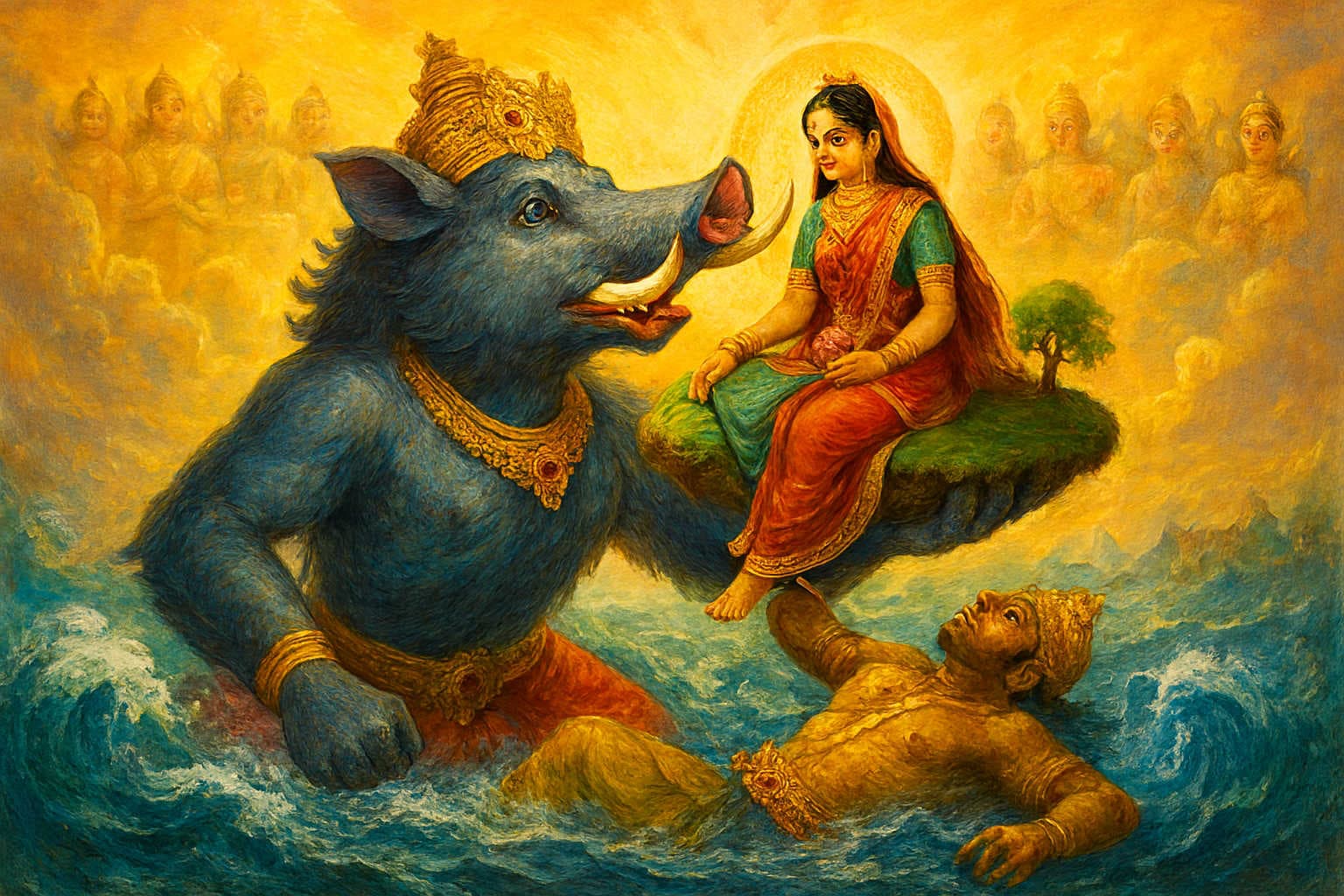
As Varaha descended into the ocean, He found Mother Earth (Bhudevi) lying helpless at the bottom, covered by darkness and chaos. Lifting her gently on His mighty tusks, He began to rise toward the surface. But Hiranyaksha was not willing to give up easily.
The demon, consumed by rage, confronted Varaha and challenged Him to a duel. What followed was an epic battle that lasted for thousands of years according to the scriptures. The clash of their weapons created waves that shook the universe. Finally, with His divine strength and weaponry, Lord Varaha slayed Hiranyaksha and restored cosmic order.
The Rescue of Bhudevi
After defeating the demon, Lord Varaha placed Bhudevi safely back in her orbit, allowing life and creation to continue. Overwhelmed with gratitude, Mother Earth praised Lord Vishnu for His boundless compassion and courage. This act of restoration marked a new beginning for the world.
Symbolism of Varaha Avatar
The Varaha Avatar carries profound spiritual and philosophical meaning:
-
Earth as the Foundation of Life – The story reminds us of the importance of nature and the Earth as the basis of existence.
-
The Ocean as Chaos – The cosmic waters represent disorder and ignorance, from which divine wisdom rescues us.
-
The Boar as Determination – The boar’s strength and persistence signify the power needed to overcome adversity.
-
Hiranyaksha as Ego – The demon embodies arrogance, which drags goodness into darkness; divine intervention restores balance.
Connection to Evolution
Interestingly, the Dashavatara sequence aligns with Darwin’s theory of evolution. Varaha, being an animal that thrives on land after Matsya (fish) and Kurma (tortoise), symbolizes the stage when life moved from aquatic to terrestrial existence.
Worship and Festivals
The Varaha Avatar is worshipped in many parts of India. Varaha Jayanti, marking His appearance, is observed during the month of Bhadrapada (August-September). Temples dedicated to Varaha exist in Tirupati (Andhra Pradesh), Pushkar (Rajasthan), and Khajuraho (Madhya Pradesh).
Lessons from Varaha Avatar
-
Divine strength always overcomes demonic arrogance.
-
The Earth must be preserved and protected for life to sustain.
-
Righteousness and faith ensure victory over chaos and ignorance.
Philosophical Message
The Varaha story reminds us that whenever evil and imbalance threaten creation, divine power will manifest to restore Dharma. It also emphasizes the sacredness of the Earth, urging us to care for nature and live harmoniously.
Conclusion
The Varaha Avatar of Lord Vishnu is a timeless tale of courage, compassion, and cosmic balance. It teaches that even in the darkest depths, divine grace can lift us toward light and renewal. By saving Mother Earth, Lord Varaha not only restored the physical world but also re-established the eternal truth that goodness will always triumph over evil.