Matsya Avatar – The Great Flood
The Matsya Avatar marks the first incarnation of Lord Vishnu in the Dashavatara sequence and represents the beginning of life and order after chaos. This divine story, narrated in the Satapatha Brahmana, Mahabharata, and Puranas, describes how Lord Vishnu took the form of a giant fish to save Manu, the Vedas, and all living beings during the Great Flood.
The Prelude – The Warning of a Catastrophe
Long ago, during the age of cosmic dissolution, there lived a righteous king named Satyavrata, who later came to be known as Vaivasvata Manu, the progenitor of mankind. One day, while performing his morning ablutions in a river, Manu cupped some water in his hands and found a tiny fish struggling for life.
The fish pleaded,
"O noble king, protect me from larger fish who seek to devour me. If you save me, I shall save you in your hour of need."
Moved by compassion, Manu placed the fish in a small pot. However, the fish began growing at an astonishing rate. Manu transferred it to a bigger pot, then a pond, then a lake, and finally into the vast ocean. Realizing that this was no ordinary creature, Manu folded his hands and prayed.
The fish revealed its true identity:
"I am Lord Vishnu, the preserver of the universe. Soon, a great flood will engulf the earth. Build a massive boat, take with you the Saptarishis (seven sages), seeds of all plants, and specimens of every creature. When the flood comes, I shall guide you to safety."
The Great Deluge – Pralaya Begins
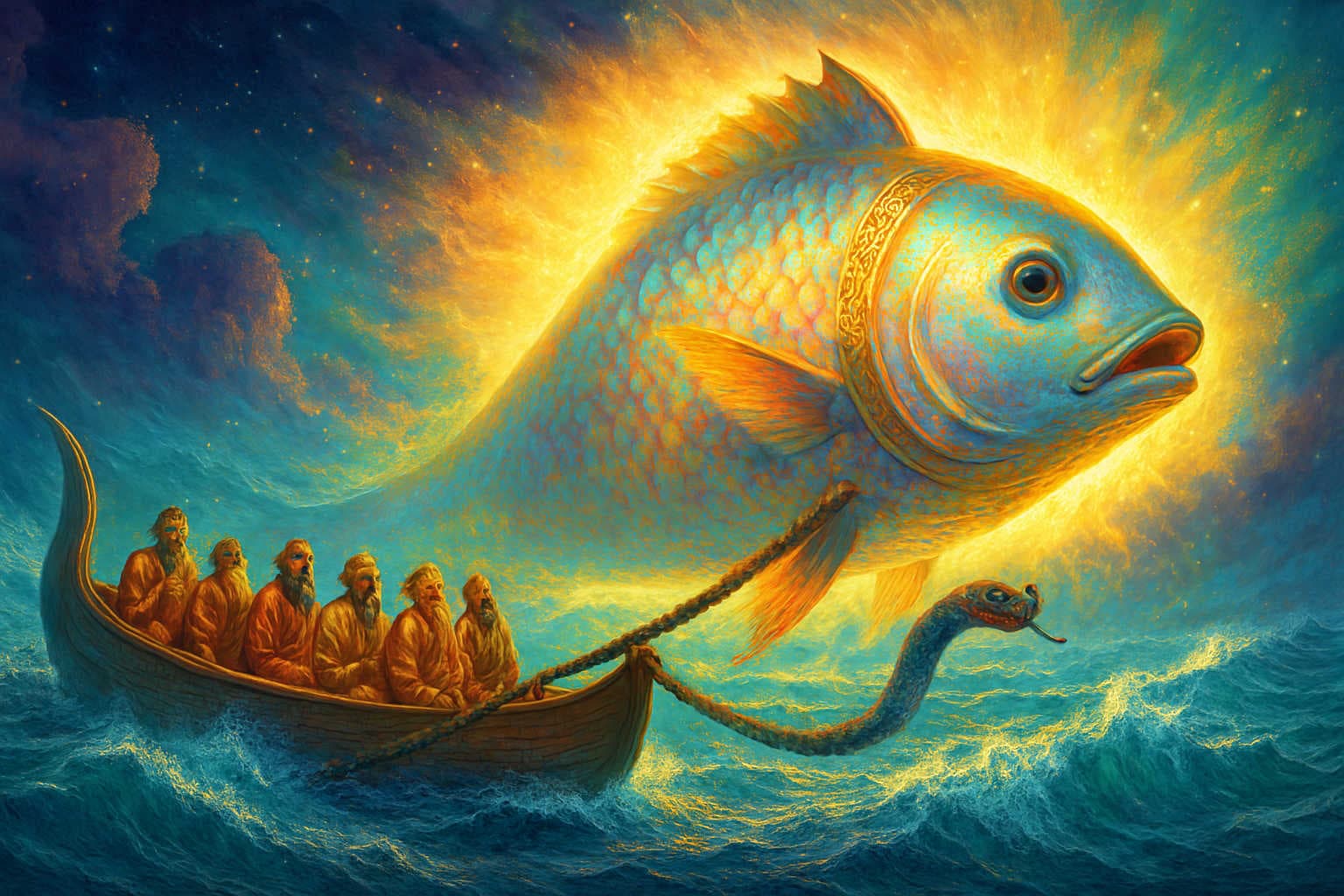
As predicted, dark clouds filled the skies, and torrential rains began. The waters rose higher and higher, submerging mountains and valleys. The Pralaya (cosmic dissolution) had arrived. Manu, with the sages and all forms of life, boarded the gigantic boat he had prepared.
True to His word, Lord Vishnu appeared as Matsya, an enormous fish with a golden horn on His head. Manu tied the boat to this horn using the serpent Vasuki as a rope, and Matsya swam across the infinite ocean, guiding them to safety.
The Protection of the Vedas
During the flood, an asura named Hayagriva tried to steal the sacred Vedas, which contained the essence of knowledge and creation. Lord Vishnu, in His Matsya form, defeated the asura and restored the Vedas to Brahma, ensuring that wisdom was preserved for the next cycle of creation.
After the Flood – A New Dawn
When the waters subsided, Matsya led the boat to the peak of the Himalayas (some texts mention Mount Himavan). Manu and the sages stepped out and began the task of repopulating the earth and re-establishing Dharma. Thus began a new cycle of life, marking the transition from chaos to order.
Symbolism of Matsya Avatar
The Matsya Avatar is rich in symbolism and philosophical depth:
-
Fish as the Life Preserver – Fish is one of the earliest forms of life on Earth, symbolizing the start of evolution.
-
Boat as Knowledge and Faith – It represents guidance and protection in times of crisis.
-
The Flood as Ignorance – The deluge signifies overwhelming chaos, which only divine intervention and wisdom can overcome.
-
The Vedas as Eternal Truth – Their protection shows that spiritual wisdom survives even the greatest destruction.
Matsya in Dashavatara
Being the first of the ten avatars, Matsya marks the evolutionary stage of life in water, followed by Kurma (tortoise) and Varaha (boar), symbolizing progression from aquatic to amphibious to terrestrial beings. This aligns with Darwin’s theory of evolution, making the story both spiritual and scientific.
Philosophical Insights
The tale of Matsya teaches us that:
-
Faith and righteousness ensure protection in adversity.
-
Knowledge (Vedas) must be safeguarded for the continuity of Dharma.
-
Every end is a new beginning – destruction paves the way for renewal.
Festivals and Worship
The Matsya Avatar is worshipped in various parts of India, especially during Matsya Jayanti, which falls in the Chaitra month (March-April). Temples dedicated to Matsya can be found in Andhra Pradesh, Tamil Nadu, and Rajasthan.
Modern Relevance
Even today, the story of Matsya Avatar resonates deeply. In a world often engulfed by metaphorical floods of greed, ignorance, and conflict, the Matsya tale reminds us to cling to faith, wisdom, and righteousness to survive and thrive.
Lessons from Matsya Avatar
-
Compassion leads to divine blessings – Manu’s act of saving the tiny fish brought him Lord Vishnu’s grace.
-
Preparation is key – Manu’s timely actions saved humanity.
-
Knowledge is the ultimate savior – Without the Vedas, the world would lack guidance.
Conclusion
The story of the Matsya Avatar and the Great Flood is not just a myth; it is a profound allegory of faith, wisdom, and renewal. It assures us that when darkness looms and chaos threatens existence, the divine will manifest to guide, protect, and preserve the eternal truth.