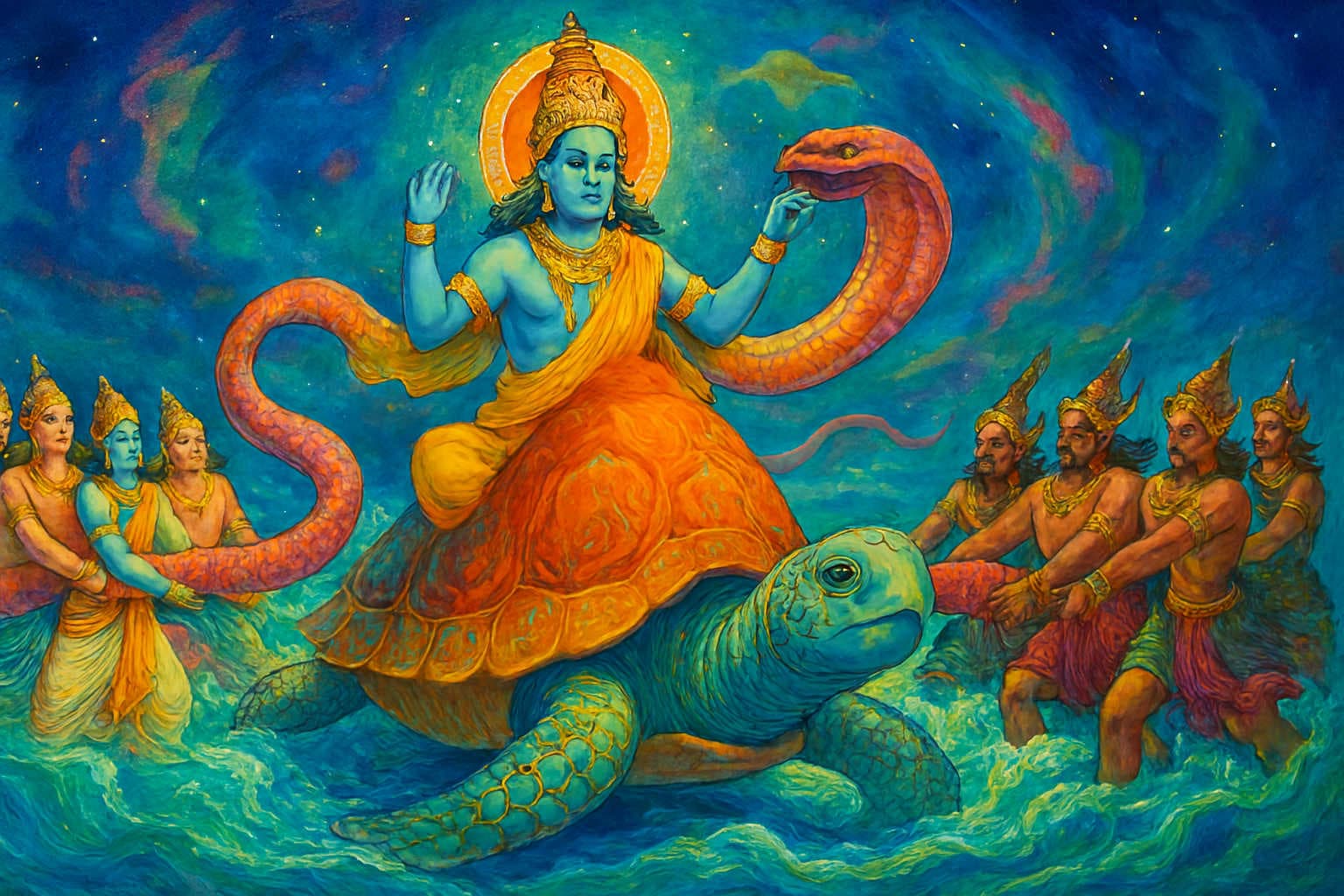
Kurma Avatar and Mandara Mountain
The story of the Kurma Avatar is a fascinating episode from Hindu mythology that symbolizes stability, cooperation, and divine intervention. This avatar is the second incarnation of Lord Vishnu in the Dashavatara sequence, where He takes the form of a giant tortoise to assist the Devas (gods) and Asuras (demons) in the Samudra Manthan – the Churning of the Ocean of Milk.
The Background – Why Was the Ocean Churned?
The story begins with the Devas and Asuras locked in an eternal struggle for supremacy. After several battles, the Devas were weakened and approached Lord Vishnu for help. Vishnu advised them to obtain Amrita (nectar of immortality) from the Kshira Sagara (Ocean of Milk) through churning. However, this was a colossal task requiring immense strength, so the Devas had to strike a temporary truce with the Asuras and work together.
The Great Plan for Samudra Manthan
To churn the cosmic ocean, they needed a churning rod and a rope. The massive Mandara Mountain was chosen as the churning rod, and Vasuki, the king of serpents, became the rope. The Devas held Vasuki’s tail while the Asuras, eager for supremacy, grabbed his head.
But as they began the churning, an unexpected problem arose: Mandara Mountain started sinking into the ocean due to its enormous weight. Both Devas and Asuras were helpless. It was then that Lord Vishnu took a remarkable form to save the situation.
The Kurma Avatar – The Divine Tortoise
Vishnu assumed the form of Kurma, a gigantic tortoise, and descended into the ocean. He placed Mandara Mountain on his strong back, providing a stable base for the churning process. With this divine support, the churning resumed, and the cosmic event unfolded.
The Kurma Avatar symbolizes foundation and stability, teaching us that even the greatest endeavors require a strong base and divine support.
The Churning of the Ocean – Wonders and Dangers
As the churning progressed, several extraordinary items emerged from the ocean:
-
Halahala (Deadly Poison) – The first product was a terrifying poison capable of destroying all creation. Lord Shiva, in His infinite compassion, consumed it to protect the universe, earning the name Neelkantha.
-
Kamadhenu (Wish-fulfilling Cow) – Symbol of abundance.
-
Airavata (Celestial Elephant) and Uchhaishravas (Divine Horse).
-
Kalpavriksha (Wish-fulfilling Tree) and Apsaras (Celestial Nymphs).
-
Goddess Lakshmi – Who chose Vishnu as Her eternal consort.
-
Dhanvantari – The divine physician appeared carrying the pot of Amrita (nectar).
When Amrita appeared, greed overtook the Asuras. They seized the pot, but once again, Vishnu intervened as Mohini, the enchantress, to ensure the nectar reached the Devas, restoring cosmic balance.
Symbolism of the Kurma Avatar
The Kurma Avatar is more than a mythological tale; it is a treasure trove of spiritual meaning:
-
Stability in Turmoil – The tortoise, with its strong shell, represents stability amidst chaos.
-
Support for Righteous Efforts – Divine support comes when actions are aligned with Dharma.
-
Teamwork and Balance – Devas and Asuras, despite enmity, had to cooperate for a greater purpose.
-
Hidden Strength – Just like Kurma, true strength lies in patience and endurance.
Kurma in Dashavatara
As the second avatar of Vishnu, Kurma follows Matsya (fish) and precedes Varaha (boar). While Matsya saved the world from the great flood, Kurma provided the foundation for the cosmic churning—a step forward in the evolution of life and order.
Philosophical Insights
The story also reflects a deep spiritual metaphor. The ocean is the mind, the mountain is the resolve, and the churning symbolizes the effort to extract spiritual wisdom. The poison represents negativity that surfaces during this process, while Amrita signifies ultimate knowledge and liberation.
Festivals and Worship
The Kurma Avatar is particularly revered in Andhra Pradesh, where the Srikurmam Temple in Srikakulam is dedicated to this form of Vishnu. Devotees worship Kurma for strength, stability, and success in endeavors.
Lessons from the Kurma Avatar
-
Every great task needs a firm foundation – Without Kurma, the churning would have failed.
-
Patience and perseverance bring divine rewards – The churning took immense effort, but the result was Amrita.
-
Balance of opposites is necessary – Even rivals must work together for a greater good.
Modern Relevance
In today’s fast-paced life, the Kurma Avatar teaches us to stay grounded and maintain inner stability amid challenges. Just as the tortoise withdraws into its shell for protection, we too need moments of introspection and calm to face life’s turbulence.
Conclusion
The tale of Kurma Avatar and Mandara Mountain is a shining example of divine intervention, teamwork, and the ultimate triumph of stability over chaos. It is a reminder that even when life feels like a turbulent ocean, the divine always provides a steady foundation to help us endure and succeed.