Samudra Manthan – The Churning of the Ocean
The Hindu scriptures are filled with fascinating stories that reveal profound spiritual truths. One of the most famous and symbolic episodes is Samudra Manthan, also known as the Churning of the Ocean of Milk. This story from the Bhagavata Purana, Vishnu Purana, and Mahabharata is not just a tale of gods and demons but a cosmic drama that explains the eternal struggle between good and evil, perseverance, and divine intervention.
Why Did the Churning Begin?
The story begins after the Devas (gods) were weakened by a curse from Sage Durvasa. The curse stripped them of their strength, making them vulnerable to the Asuras (demons), who began to overpower them. Defeated and desperate, the Devas approached Lord Vishnu for guidance.
Vishnu advised them to form an alliance with the Asuras to churn the Kshira Sagara (Ocean of Milk) and obtain the Amrit (nectar of immortality). Drinking Amrit would restore their strength and grant them immortality, ensuring victory over evil.
However, Vishnu also warned that this task would not be easy—it would require great cooperation, patience, and divine support.
The Great Alliance and Preparation
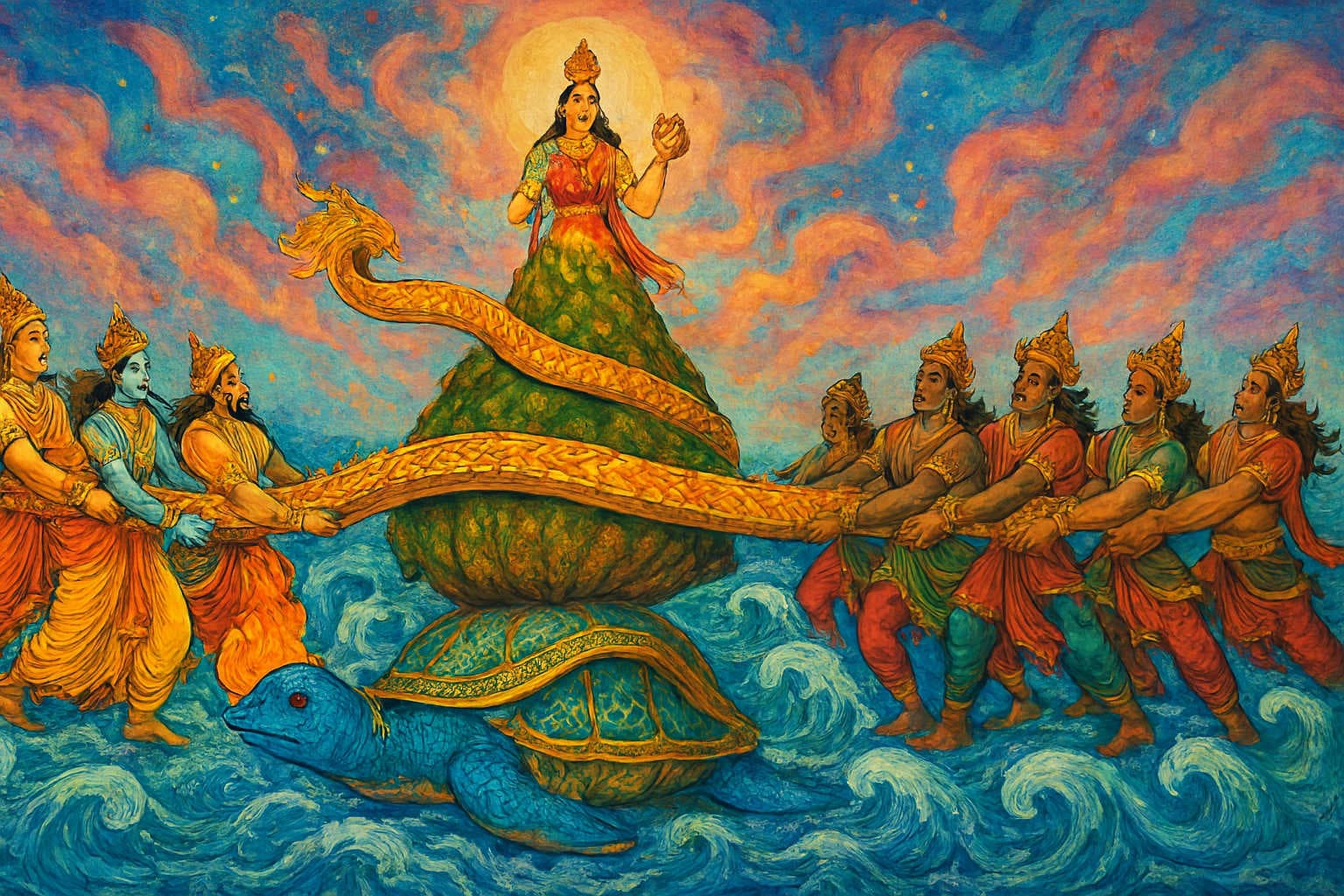
Reluctantly, the Devas and Asuras agreed to work together. For the churning rod, they used the mighty Mount Mandara, and for the rope, they chose the celestial serpent Vasuki, king of serpents.
But there was a problem—how could they prevent Mount Mandara from sinking in the ocean? Once again, Lord Vishnu intervened, taking the Kurma Avatar (tortoise incarnation) and supporting the mountain on his broad back. This ensured the churning could begin.
The Process of Churning
With Devas on one side and Asuras on the other, they wrapped Vasuki around the mountain and began pulling alternately. The ocean started churning, and waves surged higher and higher. The process was intense, symbolic of the struggle between good and evil, effort and perseverance.
As the churning continued, many miraculous and dangerous things emerged from the ocean—some divine treasures, others poisonous and deadly.
What Emerged from the Ocean?
The Samudra Manthan brought forth 14 Ratnas (divine treasures) and beings, each with its own significance. Some of the most notable were:
-
Halahala – The deadly poison capable of destroying all creation. It was swallowed by Lord Shiva, who held it in his throat, turning it blue, earning the name Neelkantha.
-
Kamadhenu – The celestial cow that fulfills all desires.
-
Airavata – The white elephant, later taken by Indra.
-
Kalpavriksha – The wish-fulfilling tree.
-
Apsaras – Divine nymphs of unparalleled beauty.
-
Chandra – The moon, which adorned Shiva’s head.
-
Dhanvantari – The divine physician, who emerged holding the Amrit.
-
Amrit – The nectar of immortality, the ultimate goal of the churning.
The Struggle for Amrit
When Dhanvantari appeared with the pot of Amrit, the Asuras immediately tried to seize it. A fierce conflict broke out between the Devas and Asuras. To resolve this, Vishnu took the form of Mohini, an enchanting maiden, to distract the Asuras. Fascinated by her beauty, they allowed her to distribute the nectar, unaware that Mohini would favor the Devas.
Rahu and Ketu – The Birth of Eclipses
As Mohini served the Amrit to the Devas, one Asura, Swarbhanu, disguised himself as a Deva and drank the nectar. But before it could pass his throat, Vishnu, in his true form, cut off his head with the Sudarshana Chakra. His head and body became Rahu and Ketu, celestial entities responsible for eclipses.
The Devas Regain Power
With the nectar consumed, the Devas regained their strength and immortality. The alliance was broken, and the Devas defeated the Asuras, restoring order in the universe. Thus ended one of the greatest cosmic episodes in Hindu mythology.
Symbolism and Deeper Meaning
The Samudra Manthan is more than a myth—it’s a metaphor for life and spiritual growth:
-
Ocean of Milk – Represents the mind, deep and vast.
-
Mount Mandara – Represents concentration and determination.
-
Vasuki (serpent) – Symbolizes desires and ego, which help churn the mind.
-
Poison (Halahala) – Represents the negativity that surfaces during self-purification.
-
Amrit (nectar) – Represents ultimate wisdom and liberation.
-
Cooperation of Devas and Asuras – Shows that both positive and negative forces are needed for transformation.
The lesson is clear—progress requires patience, effort, and the ability to handle both good and bad outcomes with grace.
Modern Relevance of Samudra Manthan
This ancient tale still holds profound relevance. In our lives, churning represents struggles, challenges, and inner battles. Only by enduring hardships and managing our inner demons can we attain the Amrit of peace, success, and spiritual enlightenment.
Key Lessons from Samudra Manthan
-
Endurance is Essential – Great results come only after immense effort.
-
Balance of Opposites – Even negative forces can serve a higher purpose.
-
Divine Guidance Matters – The presence of a guiding force ensures victory.
-
Control of Desires – Just as poison emerged, our desires can be toxic if unchecked.
Why This Story Lives On
The Samudra Manthan continues to inspire art, literature, and spiritual discourse. It is a reminder that life’s ultimate treasures are not obtained easily—they require effort, sacrifice, and divine grace.