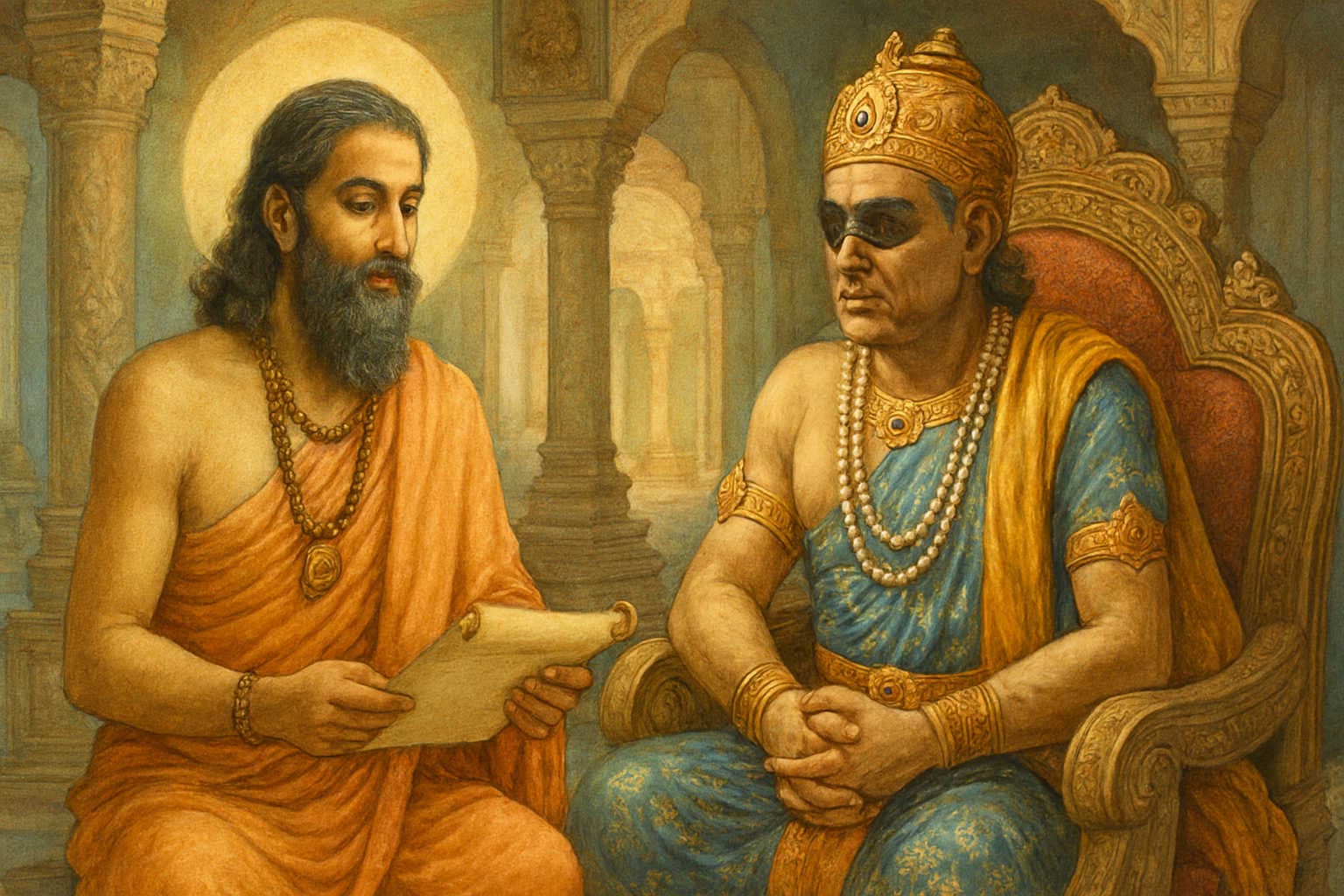
Vidur – The Voice of Wisdom
Among the countless characters of the Mahabharata, Vidur stands out not for strength or royalty but for his unwavering wisdom, righteousness, and integrity. Born under unusual circumstances, Vidur became the moral compass of the Kuru dynasty, offering guidance rooted in dharma at a time when ambition and greed clouded judgment.
Who Was Vidur?
Vidur was the son of Sage Vyasa and a maidservant of the royal palace. When Queen Satyavati requested Vyasa to father children with the widowed queens Ambika and Ambalika (to continue the Kuru lineage), a maid also bore a child through Vyasa. This child was Vidur. Though born outside royal privilege, Vidur’s intellect, sense of justice, and devotion to dharma earned him respect throughout the kingdom.
He became the chief advisor to King Dhritarashtra and played a key role in guiding the court during turbulent times.
The Embodiment of Dharma
Vidur lived by the principles of righteousness. Unlike many courtiers swayed by favoritism or fear, Vidur spoke the truth without hesitation—even when it displeased the king. His words were considered law by many because they were grounded in Vidur Niti—a set of ethical and political maxims that continue to inspire leaders and thinkers today.
Vidur’s Role in Mahabharata
When the seeds of the Kurukshetra war were being sown, Vidur foresaw the catastrophic consequences of greed and arrogance. He repeatedly warned Dhritarashtra about Duryodhana’s behavior and the injustice done to the Pandavas.
The Dice Game and Vidur’s Warning
Before the infamous dice game that led to Draupadi’s humiliation, Vidur strongly advised against inviting Yudhishthira. He warned Dhritarashtra:
“Gambling destroys wealth, breeds enmity, and clouds wisdom.”
But his counsel was ignored. Later, when Draupadi was dragged into the court, Vidur condemned the act as adharma, reminding everyone that righteousness should never be abandoned for pride.
Vidur Niti – The Teachings of Vidur
One of Vidur’s greatest contributions is Vidur Niti, a collection of timeless aphorisms on ethics, politics, and life. These teachings remain relevant even today. Some key principles include:
-
Truth and Justice Above All:
A kingdom thrives when justice prevails and rulers uphold truth. -
Control of Desire:
Desire leads to downfall. A wise person remains content with what is rightfully earned. -
Value of Patience and Humility:
Anger and arrogance destroy relationships and peace. -
Choosing Good Company:
Association with virtuous people brings progress, while bad company leads to ruin.
These lessons are not just political strategies but moral guidelines for personal life.
The Exile of the Pandavas
When the Pandavas were sent into exile after losing the dice game, Vidur was deeply saddened. He considered Yudhishthira the ideal king and believed the kingdom’s future lay in his hands. Before they left, Vidur comforted them and reminded them that truth and virtue always triumph over deceit.
Vidur and Krishna – Shared Wisdom
Vidur shared a deep spiritual bond with Lord Krishna. When Krishna visited Hastinapura as a peace messenger, he chose to stay at Vidur’s humble house rather than the royal palace. Vidur’s hospitality was simple yet heartfelt—he offered Krishna fruits and roots with pure devotion. This episode symbolizes that God values love and sincerity over grandeur.
Vidur’s Disapproval of War
As tensions escalated between the Kauravas and Pandavas, Vidur pleaded with Dhritarashtra to avoid war. He reminded the blind king that a war would destroy the entire Kuru lineage. Unfortunately, his advice fell on deaf ears. Duryodhana’s arrogance overshadowed wisdom, leading to the devastating battle of Kurukshetra.
Why Vidur Matters Today
Vidur’s life is a beacon of integrity in times of corruption and moral decay. His teachings urge us to:
-
Speak the truth fearlessly, even in difficult situations.
-
Value justice over favoritism.
-
Lead a life of simplicity and humility.
-
Control anger and greed, which lead to downfall.
In a world where ethics often take a backseat to ambition, Vidur’s principles serve as a guiding light.
Spiritual Lessons from Vidur’s Life
-
Wisdom is greater than birth. Vidur was not a prince, yet his advice shaped the fate of kingdoms.
-
Dharma protects those who protect it. Vidur never compromised on righteousness, even when pressured by the powerful.
-
Simplicity is strength. His humble lifestyle made him spiritually rich.
Vidur’s Later Life
After the war, Vidur renounced his royal duties and retired to the forest, seeking peace and spiritual liberation. He spent his final years in meditation and attained union with the divine—proving that true greatness lies in wisdom and virtue, not power or wealth.
Conclusion
Vidur—the voice of wisdom in Mahabharata—remains a timeless example of integrity, truth, and dharma. His life and teachings remind us that right conduct and righteousness outshine status and strength. In an era of moral dilemmas, Vidur’s voice still whispers the eternal truth: “Choose dharma, for it never fails.”