The Yaksha Prashna and Yudhishthira’s Wisdom
The Mahabharata is a treasure trove of timeless wisdom, and one of its most profound episodes is the Yaksha Prashna—a dialogue between Yudhishthira and a mystical being disguised as a Yaksha. This story, set during the Pandavas’ exile, is more than a tale of riddles; it is a deep exploration of life, dharma, and spiritual truth.
The Setting – Pandavas in Exile
After losing the dice game, the Pandavas spent thirteen years in exile. During the twelfth year, they wandered through dense forests, enduring hardships. One day, while pursuing a deer that had stolen a Brahmin’s sacred fire sticks, the Pandavas grew thirsty. In search of water, Nakula, the youngest brother, came across a shimmering lake. But the lake was guarded by a mysterious Yaksha.
As Nakula bent to drink, the Yaksha warned:
“Answer my questions before you drink. Disobey, and you will die.”
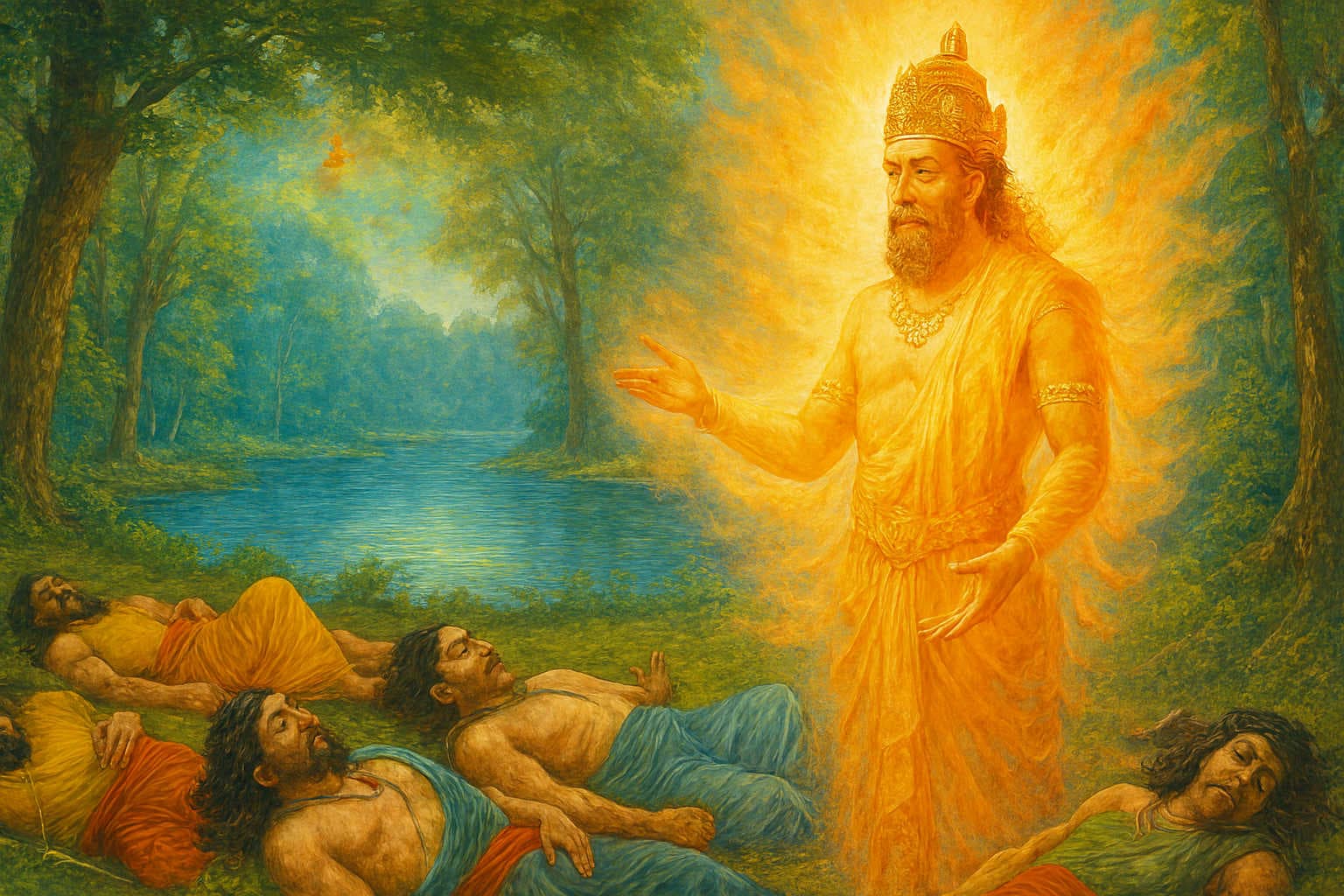
Nakula ignored the warning and drank the water—only to fall dead instantly. One by one, Sahadeva, Arjuna, and Bhima followed, meeting the same fate. Finally, Yudhishthira arrived at the lake.
The Encounter with Yaksha
Yudhishthira saw his brothers lying motionless and the strange being before the lake. The Yaksha repeated his warning:
“Answer my questions before you drink, or you too will perish.”
Yudhishthira, wise and patient, agreed. Thus began the famous Yaksha Prashna—a series of riddles and philosophical questions that tested Yudhishthira’s wisdom, patience, and dharmic understanding.
The Questions and Answers
The Yaksha asked more than 100 questions, but some stand out for their timeless relevance:
-
Yaksha: “What is the greatest wonder in this world?”
Yudhishthira: “Every day, countless beings die, yet the living wish to live forever. This is the greatest wonder.” -
Yaksha: “What is the path of righteousness?”
Yudhishthira: “The path followed by great souls and approved by the wise is dharma.” -
Yaksha: “What is true wealth?”
Yudhishthira: “Contentment is the greatest wealth.” -
Yaksha: “Who is truly happy?”
Yudhishthira: “One who cooks simple food, owes no debt, and lives content with his family.” -
Yaksha: “What is the greatest duty of a man?”
Yudhishthira: “To do good to others is the highest duty.”
These answers revealed the depth of Yudhishthira’s understanding. His responses were not just clever but rooted in dharma and spiritual truth.
The Final Test
After answering all questions, the Yaksha offered Yudhishthira a boon: he could revive one brother. Yudhishthira chose Nakula, the youngest son of his stepmother Madri. The Yaksha, surprised, asked why he did not choose Bhima or Arjuna—his strongest and most skilled brothers.
Yudhishthira replied:
“My father had two wives, Kunti and Madri. I am alive as Kunti’s son. To be fair, Madri should also have a son alive. This is dharma.”
The Yaksha, impressed by his fairness and wisdom, revealed his true identity: Dharmaraja, the god of righteousness—Yudhishthira’s divine father. He revived all four brothers and blessed them with strength for the remaining exile.
The Essence of Yaksha Prashna
This episode is more than a tale of questions and answers. It teaches us:
-
Wisdom is greater than strength. The might of Bhima and the skill of Arjuna could not save them; only wisdom did.
-
Patience and humility lead to survival. Yudhishthira listened, reflected, and answered truthfully.
-
Dharma is about fairness and balance. His choice of Nakula shows impartiality and justice.
Why This Story Still Matters
In today’s fast-paced world, the Yaksha Prashna reminds us of simple truths:
-
Wealth and power are temporary; contentment is real wealth.
-
Life is uncertain; death is inevitable, yet we live in denial.
-
The greatest duty is kindness.
-
Fairness and integrity must guide decisions, even in hardship.
Spiritual Significance
The Yaksha represents the higher self—the voice of conscience that questions us when we act impulsively. Yudhishthira symbolizes the ideal seeker, who chooses truth over haste, wisdom over desire. The lake signifies life itself: tempting, but requiring moral strength to access its purity.
Lessons from the Yaksha Prashna
-
Answer life’s questions with mindfulness.
Every challenge is a question life poses. Our responses define our destiny. -
Righteousness over favoritism.
Yudhishthira’s choice shows that dharma requires impartiality. -
Wisdom sustains life.
Physical power fades; wisdom endures.
Conclusion
The Yaksha Prashna is not just a Mahabharata episode—it is a guide for life. It urges us to reflect on deeper truths, live with integrity, and embrace humility. In times of moral confusion, Yudhishthira’s wisdom lights the path of dharma.