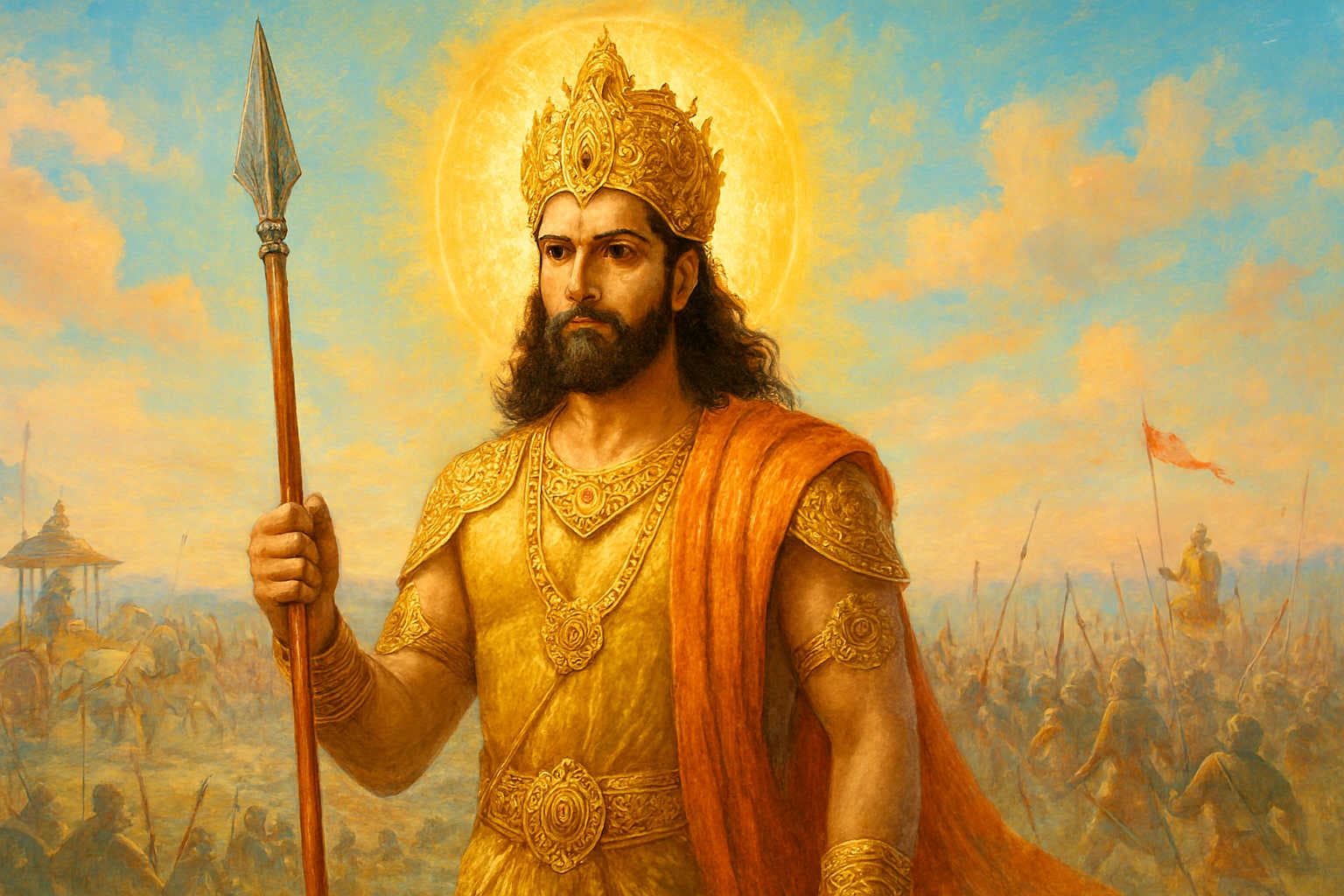
Yudhishthira’s Dharma Yudh
The Mahabharata is not just an epic of war; it is a profound discourse on dharma—righteousness. Among all the characters in this epic, Yudhishthira, the eldest of the Pandavas, stands as the embodiment of dharma. His journey through the Kurukshetra war was not merely a physical battle but an inner struggle to uphold righteousness amid chaos, deceit, and bloodshed. This is the story of Yudhishthira’s Dharma Yudh—a war of principles in the heart of a warrior king.
Who Was Yudhishthira?
Yudhishthira, also known as Dharmaraja, was the son of Kunti and Lord Yama (the god of dharma). From birth, he was destined to represent justice and truth. Unlike his brothers—Bhima with his strength, Arjuna with his skill, and Nakula-Sahadeva with their wisdom—Yudhishthira’s greatest weapon was his unwavering commitment to dharma.
He believed that truth and righteousness must prevail even in the harshest circumstances. However, the Kurukshetra war challenged these ideals in ways he never imagined.
The Dilemma of Dharma in War
When the Pandavas were forced into exile after losing the dice game, Yudhishthira bore the guilt of gambling away his kingdom, his wealth, and even his wife Draupadi. For thirteen years, he reflected on his duty, his mistakes, and the meaning of dharma.
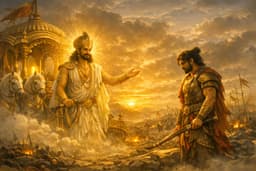
When Krishna approached him with the necessity of war, Yudhishthira hesitated. For him, the thought of killing his elders—Bhishma, his guru Drona, and relatives—was unbearable. Could a war that required the slaughter of kin ever be righteous?
Krishna reminded him:
“Dharma does not mean avoiding battle when adharma rises. Your duty as a king is to protect justice and restore balance.”
The Start of Dharma Yudh
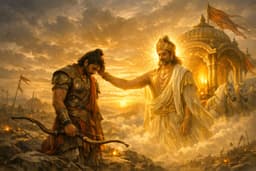
As the war began, Yudhishthira made a solemn declaration: he would fight only for justice, not for revenge or greed. Before the first arrow was shot, he removed his armor and walked to the Kaurava side to seek blessings from Bhishma, Drona, and Kripacharya. This act symbolized that his war was not born of hatred but of duty.
He said:
“I bow before my elders. I fight not against you, but against adharma.”
Moments That Tested Yudhishthira’s Dharma
The eighteen-day war was full of moments that shook Yudhishthira’s moral ground. Among the most difficult was the death of Drona. Drona was nearly invincible, and Krishna devised a plan: tell Drona that his beloved son Ashwatthama was dead. When Drona asked Yudhishthira the truth, the burden fell upon him.
Yudhishthira uttered:
“Ashwatthama is dead… the elephant.”
He spoke the truth, but with ambiguity, causing Drona to lay down his arms. This incident scarred Yudhishthira deeply, as he felt he had compromised his lifelong commitment to truth for victory.
Why Yudhishthira Never Wanted Kingship
Unlike his brothers, Yudhishthira never desired power. His idea of kingship was rooted in service, not authority. Yet, destiny placed the crown upon his head. He often questioned:
“Is ruling a kingdom worth the river of blood shed in Kurukshetra?”
Even after victory, Yudhishthira was consumed by guilt. The sight of millions of corpses haunted him, and he considered renouncing the throne to live as a hermit. Only Krishna’s wisdom restored his sense of purpose.
The Essence of Dharma Yudh
Yudhishthira’s battle was not just against Duryodhana—it was against his own doubts. His life teaches us that dharma is not black and white. Sometimes, righteousness demands hard choices. The Mahabharata calls the war a Dharma Yudh, not because everyone acted righteously, but because the ultimate goal was to restore balance and justice in society.
Lessons from Yudhishthira’s Dharma Yudh
-
Righteousness Requires Courage
Doing the right thing is often the hardest, especially when it goes against personal emotions. -
Truth Is Complex
Yudhishthira learned that absolute truth is difficult in a world of conflict; intention matters as much as action. -
Duty Above Self
He sacrificed personal happiness for the greater good, showing that leadership is about responsibility, not privilege.
Yudhishthira After the War
After the Pandavas’ victory, Yudhishthira ruled Hastinapur with justice and compassion. But his heart never found complete peace. At the end of his life, he renounced the throne and began the Mahaprasthan—the great journey to the Himalayas—seeking liberation.
Relevance Today
In today’s world, Yudhishthira’s story resonates deeply:
-
Leadership must prioritize ethics over ego.
-
Difficult decisions must be guided by moral principles, even when the path is unclear.
-
True victory is not in conquering others but in conquering inner weakness and doubt.
Conclusion
Yudhishthira’s Dharma Yudh reminds us that righteousness is not easy—it demands sacrifice, introspection, and unwavering resolve. The Mahabharata teaches that life will often place us in situations where every choice has consequences. What defines us is our commitment to doing what is just, even in the face of uncertainty.