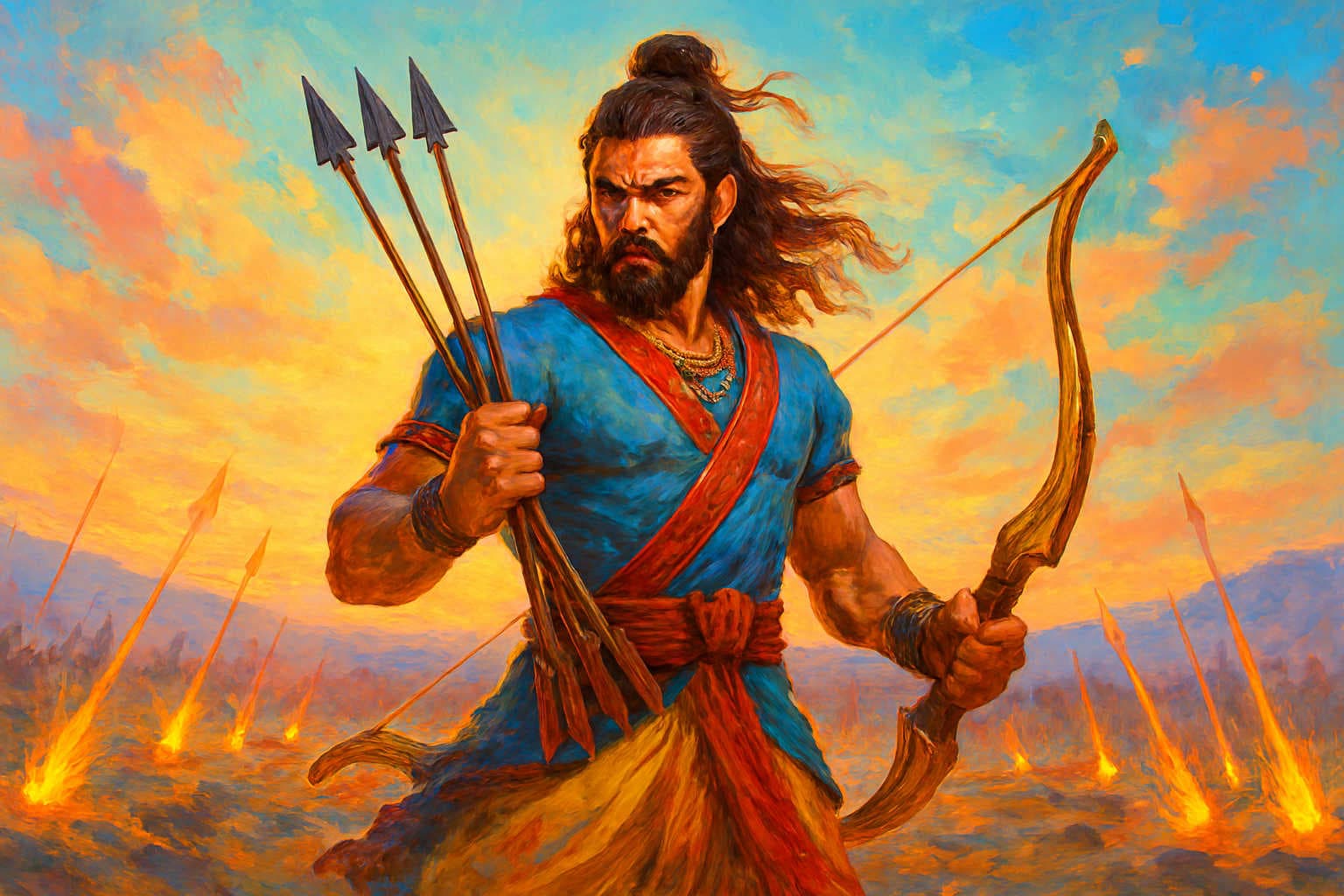
Barbarik – The Unsung Hero of Kurukshetra
The Mahabharata is full of legendary warriors—Arjuna, Bhima, Karna, Bhishma—but hidden within its vast stories lies the tale of a lesser-known yet extraordinary hero: Barbarik, the grandson of Bhima. Despite his unmatched power and devotion, Barbarik’s name rarely appears in mainstream retellings of the epic. His story is one of immense strength, sacrifice, and divine purpose, making him an unforgettable character in the great war of Kurukshetra.
Who Was Barbarik?
Barbarik was the son of Ghatotkacha (the son of Bhima and Hidimba) and Princess Maurvi, making him the grandson of Bhima and a member of the Pandava lineage. From a young age, Barbarik displayed remarkable courage and determination. Unlike ordinary warriors, Barbarik was blessed with boons and divine weapons that made him invincible on the battlefield.
The Three Arrows and Barbarik’s Vow
Barbarik was a devout follower of Lord Shiva, and after performing rigorous penance, he was granted three divine arrows and an unbreakable bow. These arrows were not ordinary—they carried unimaginable power:
-
First Arrow – Could mark all the targets to be destroyed.
-
Second Arrow – Could mark all the targets to be spared.
-
Third Arrow – Would destroy everything marked in an instant.
With just these three arrows, Barbarik could annihilate the entire army of any side in the blink of an eye.
Barbarik took a solemn vow:
“I will always fight for the weaker side in any battle.”
This promise would ultimately seal his fate in the Kurukshetra war.
Barbarik’s Arrival at Kurukshetra
As the great war of Mahabharata was about to begin, Barbarik decided to participate. Riding his blue horse, armed with his three arrows, he approached the battlefield. Hearing of a warrior so mighty that he could end the war in a single day, Lord Krishna himself decided to test Barbarik.
Krishna’s Disguise and the Test
Krishna disguised himself as a Brahmin and asked Barbarik about his intention and capabilities. Barbarik proudly explained the power of his three arrows and his vow to fight for the weaker side. Intrigued, Krishna asked:
“If you join the war, which side will you fight for?”
Barbarik replied honestly:
“I will join the weaker side, as per my vow. Initially, the Kauravas seem stronger, so I will fight for the Pandavas. But as soon as the Pandavas gain the upper hand, I will switch sides and fight for the Kauravas.”
Krishna realized that Barbarik’s presence would make the war never-ending, as he would keep shifting between sides, ensuring balance. This was against the very purpose of the war, which was to restore dharma.
The Demand for Barbarik’s Head
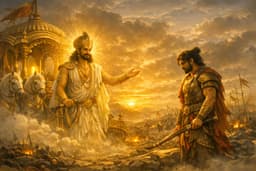
Krishna then revealed his true form and told Barbarik:
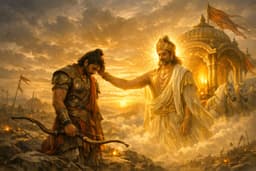
“Your intention is noble, but your vow will create chaos in this war. To maintain dharma, I must ask for your Guru Dakshina—your head.”
Barbarik was stunned but remained steadfast in his devotion. With folded hands, he agreed without hesitation, saying:
“If my head can serve a divine purpose, I offer it gladly.”
Barbarik cut off his own head and placed it at Krishna’s feet.
The Head that Witnessed the War
Moved by Barbarik’s sacrifice, Krishna granted him a boon:
“Your head will remain alive and witness the entire Kurukshetra war.”
Krishna placed Barbarik’s head on a hill overlooking the battlefield. From there, Barbarik watched the eighteen-day war unfold.
Who Was the True Victor?
After the war ended, the Pandavas argued over who was responsible for their victory. To settle the matter, Krishna brought them to Barbarik’s head and asked for his judgment. Barbarik replied:
“I saw only Lord Krishna everywhere. His Sudarshan Chakra destroyed the enemies. It was his divine will that ensured victory.”
This statement reinforced the belief that Krishna was the supreme force guiding the events of the Mahabharata.
Legacy of Barbarik – Khatushyam Ji
Barbarik is worshipped today as Khatushyam Ji in Rajasthan and other parts of India. Devotees believe that Barbarik listens to the prayers of the sincere and blesses them with strength and courage. His story is celebrated as one of the greatest examples of sacrifice, humility, and devotion to dharma.
Lessons from Barbarik’s Story
-
Unmatched Power Requires Humility
Barbarik was immensely powerful yet remained humble and obedient to dharma. -
Sacrifice for a Greater Cause
His willingness to give up his life for the sake of cosmic balance is an unparalleled act of devotion. -
The Role of Divine Will
No matter how mighty a warrior, the ultimate victory is governed by divine will and righteousness.
Relevance Today
Barbarik’s story teaches us that:
-
Power without wisdom can lead to chaos.
-
Selflessness and sacrifice are higher virtues than strength.
-
The true purpose of life lies in upholding justice and dharma.
Conclusion
Though Barbarik did not fight a single battle in the Mahabharata, his presence and sacrifice are among the most profound moments of the epic. From being a warrior capable of ending the war in a blink to becoming a silent witness to its conclusion, Barbarik’s story continues to inspire generations with its message of devotion, humility, and surrender to divine will.