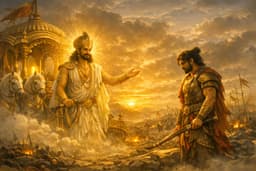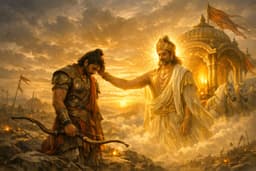
Krishna’s Departure and End of Dwapara Yuga
The Mahabharata concludes with a series of profound events that changed the course of time. Among these, the departure of Lord Krishna is one of the most significant, for it marked the end of the glorious Dwapara Yuga and the beginning of Kali Yuga, the age of darkness and decline. This story is not just about death—it is about destiny, cosmic cycles, and divine will.
The Aftermath of the War and Gandhari’s Curse
After the Kurukshetra war, Gandhari, mourning the death of her hundred sons, cursed Krishna. She declared that just as the Kuru dynasty was destroyed, so too would Krishna’s Yadava clan perish, and he would die in solitude. Krishna accepted this curse with serenity, knowing it was part of the divine plan.
Years later, the curse began to take effect. The Yadavas, once mighty and proud, fell into arrogance and discord, paving the way for their destruction.
The Destruction of the Yadavas
Thirty-six years after the war, the Yadavas gathered at Prabhasa for a festival. Intoxicated by wine and ego, they quarreled among themselves. The dispute escalated into a violent battle. They fought with iron clubs that mysteriously appeared from a cursed pestle, and the mighty clan annihilated itself in a frenzy of bloodshed. Balarama, Krishna’s elder brother, entered into deep meditation and left his mortal body, returning to the spiritual realm.
Dwaraka, the golden city of Krishna, soon sank beneath the ocean, fulfilling another prophecy. Witnessing the destruction of his beloved city and clan, Krishna knew the time had come for him to leave the mortal world.
Krishna’s Final Journey
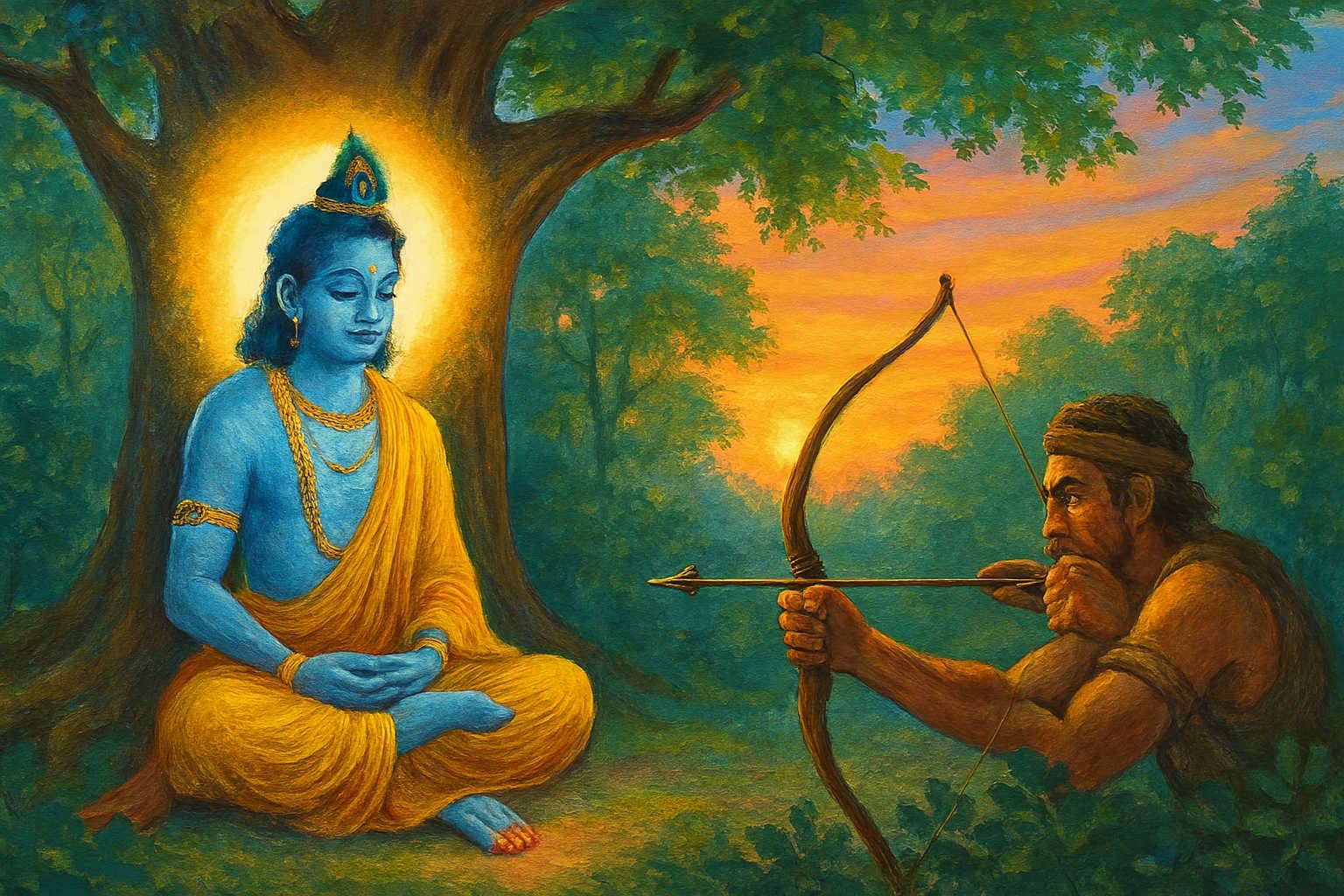
Krishna retreated to a forest near the ocean and sat under a large peepal tree. He was calm, his mind absorbed in meditation. Though his role on earth was complete, his departure had to align with the cosmic plan.
As he rested, a hunter named Jara roamed the forest. Mistaking Krishna’s partially visible foot for the mouth of a deer, Jara shot an arrow. The shaft pierced Krishna’s foot—the only vulnerable part of his divine body, as it was where the poison of Putana’s milk had once settled.
When Jara approached and realized his mistake, he fell at Krishna’s feet in despair. But Krishna, ever compassionate, consoled him:
“Do not fear, Jara. This was destined. In a previous life, you were Vaali, whom I killed. Today, that account is settled.”
Krishna’s Words Before Departure
Before leaving the world, Krishna imparted wisdom to Jara and the few remaining devotees. He reminded them that life and death are part of the eternal cycle and that his physical departure does not mean his absence—his essence remains forever in dharma, in truth, and in the hearts of devotees.
Krishna then withdrew his divine energy from the mortal body and returned to Vaikuntha, his eternal abode.
The Beginning of Kali Yuga
Krishna’s departure marked a cosmic turning point. The age of Dwapara Yuga, which lasted 864,000 years, ended with his exit. Kali Yuga, the age of spiritual decline and materialism, began at that very moment.
Hindu scriptures describe Kali Yuga as an age where:
-
Dharma stands on one foot (whereas it stood on four in Satya Yuga).
-
Greed, dishonesty, and ignorance dominate society.
-
Spirituality declines, and people prioritize material wealth over righteousness.
This age is said to last 432,000 years, and according to tradition, over 5,000 years have already passed since Krishna’s departure.
Symbolism of Krishna’s Departure
The story of Krishna’s departure is rich in meaning:
-
Even Divine Incarnations Submit to Time
Krishna, though Supreme, left the world to uphold cosmic law and complete the cycle of time. -
Destiny Cannot Be Avoided
Gandhari’s curse, the destruction of the Yadavas, and Krishna’s death were all parts of the grand design. -
The Transition of Ages
Krishna’s exit signifies the impermanence of all worldly power and the inevitability of change.
Lessons for Today
-
Humility in Prosperity – The fall of the Yadavas warns us against arrogance.
-
Faith in Eternal Values – Though Kali Yuga is an age of decline, righteousness can still flourish in individual hearts.
-
The Divine Is Always Present – Krishna’s physical departure does not diminish his eternal presence in the universe.
What Happened After Krishna’s Departure?
After Krishna left the mortal world:
-
Arjuna and the Pandavas, sensing the end of an era, renounced their kingdom and embarked on their final journey to the Himalayas.
-
Parikshit, Arjuna’s grandson, became king of Hastinapur, preserving the Kuru lineage.
-
Dwaraka submerged into the sea, leaving behind a legend of its grandeur.
Conclusion
Krishna’s departure is not merely a tale of death but a profound reminder of the cosmic rhythm of creation and destruction. His life was a divine play to uphold dharma, and his exit signified the start of a new age—Kali Yuga. Though we live in challenging times, Krishna’s teachings in the Bhagavad Gita continue to guide us through darkness toward light.