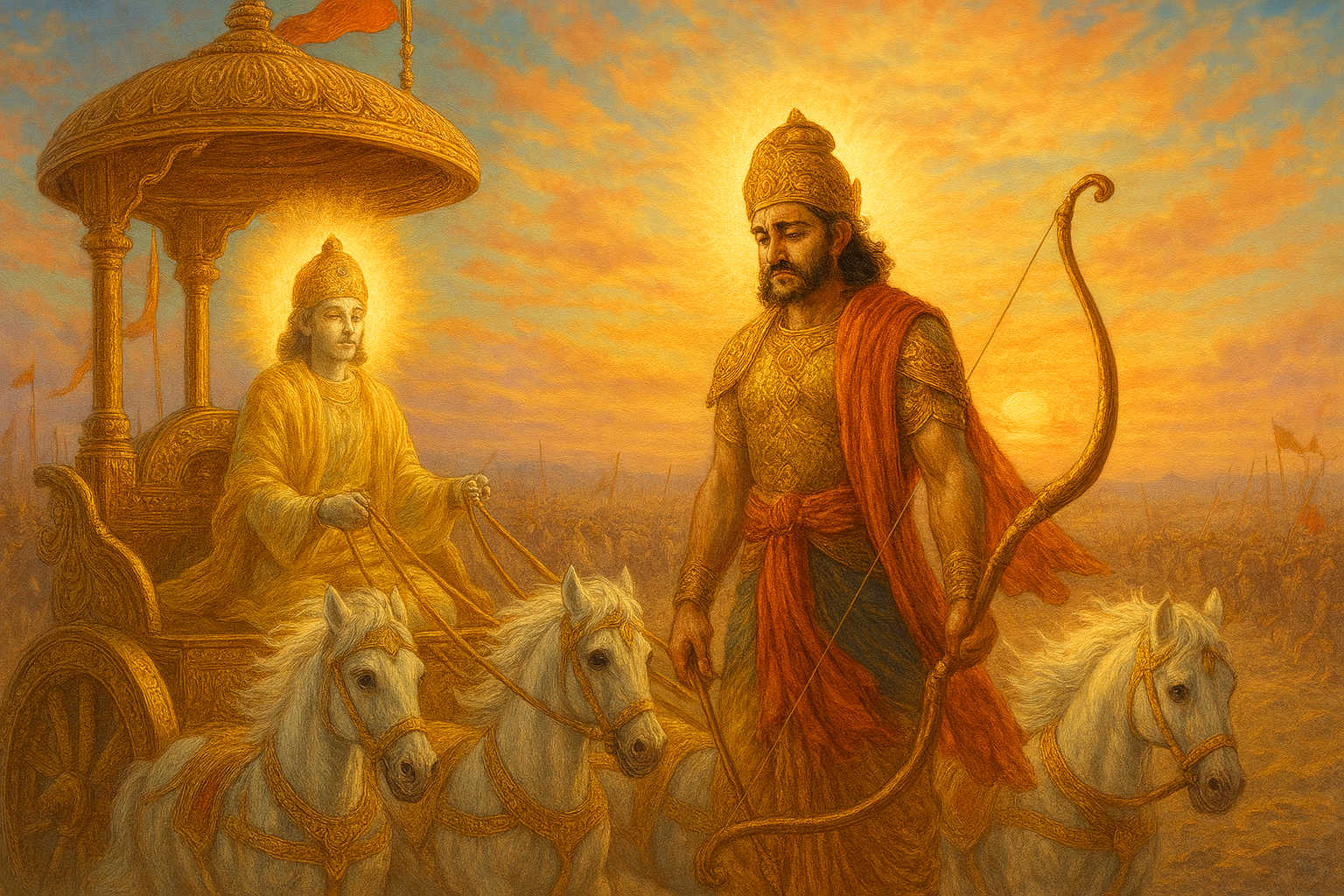
Arjuna’s Dilemma – Bhagavad Gita Begins
The great Kurukshetra war was about to begin. Conches had been blown, warriors had taken their positions, and the air was thick with anticipation. Among the greatest warriors was Arjuna, the Pandava prince and the most skilled archer of his time. Yet, at the very moment of action, Arjuna faltered. His hesitation, his inner conflict, and his profound sorrow became the foundation of one of the greatest spiritual discourses in history—the Bhagavad Gita.
The Battlefield of Kurukshetra
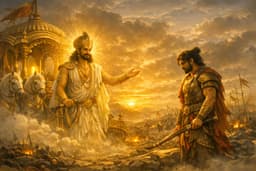
The stage was set. On one side stood the Kauravas, led by Duryodhana, and on the other, the Pandavas, led by Yudhishthira. Krishna, the divine incarnation of Vishnu, had agreed to be Arjuna’s charioteer, not a warrior. As the war drums echoed, Arjuna asked Krishna to place his chariot between the two armies to see those assembled for battle.
Arjuna’s Heart Trembles
As Arjuna looked at the opposing army, he saw familiar faces—teachers, elders, cousins, friends, and even his beloved grandfather Bhishma and guru Dronacharya. The realization struck him like a thunderbolt:
-
To win this war, he must kill his own kin.
-
Victory would be soaked in the blood of loved ones.
-
The very dharma (duty) he was fighting for seemed blurred.
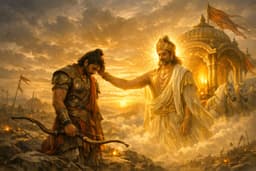
Arjuna’s bow, the mighty Gandiva, slipped from his hands. His body trembled, his mouth went dry, and tears welled up in his eyes. Overwhelmed with grief, he sank into despair and spoke to Krishna:
“How can I kill my teachers, my family, and those I respect? What joy can victory bring when it comes at the cost of their lives?”
The Dilemma Explained
Arjuna’s dilemma was not mere fear; it was a profound moral and emotional conflict:
-
Family and Relationships vs. Duty (Dharma) – Should he uphold righteousness by fighting, or should he abandon the battle to protect his loved ones?
-
Fear of Destruction – He foresaw the destruction of families and the collapse of social order.
-
Attachment and Compassion – His love for his elders and relatives clouded his sense of justice.
Arjuna even declared:
“I shall not fight, O Krishna.”
Krishna’s Response – The Beginning of the Gita
Krishna, calm and composed, began to speak. His words were not mere advice but eternal wisdom that addressed the root of human suffering and confusion.
Key Teachings of Krishna in the Beginning
-
The Soul is Eternal – “The body dies, but the soul does not. Those who are slain in battle are not truly destroyed.”
-
Do Your Duty (Svadharma) – A warrior’s duty is to fight for justice without attachment to the results.
-
Renounce Attachment to Outcomes – “Act without desire for reward. Seek perfection in action, not in results.”
This was the first step toward the profound dialogue known as the Bhagavad Gita, which transformed Arjuna from despair to determination.
Why Did Arjuna Hesitate?
-
Deep sense of empathy and compassion for both sides.
-
Fear of committing adharma (unrighteous act) by killing respected elders.
-
Anxiety about the collapse of family values and traditions.
-
Emotional turmoil from attachments clouding his intellect.
Symbolism of Arjuna’s Dilemma
Arjuna’s hesitation is symbolic of the inner battle every human faces:
-
When duty conflicts with emotion.
-
When morality seems unclear.
-
When fear paralyzes action.
The battlefield represents life, and Arjuna represents the soul seeking guidance. Krishna, the divine charioteer, represents inner wisdom and God-consciousness guiding us through confusion.
Lessons for Modern Life
-
Face your responsibilities with clarity, not with attachment.
-
Seek higher wisdom when in doubt.
-
Act righteously even when the path is difficult.
Conclusion
Arjuna’s dilemma was the doorway to the Bhagavad Gita, one of the greatest spiritual texts ever written. His hesitation and Krishna’s counsel transformed not just the course of the war but the course of human thought. Whenever we face moral confusion, the Gita remains a timeless guide.