Draupadi’s Vastraharan – Divine Intervention
The Mahabharata is filled with intense and defining moments, but none is as shocking and soul-stirring as Draupadi’s Vastraharan (disrobing). This incident not only exposed the depths of human greed and cruelty but also revealed the boundless grace of Lord Krishna. It is a story of humiliation, helplessness, and divine intervention that changed the course of history.
The Background – How It All Began
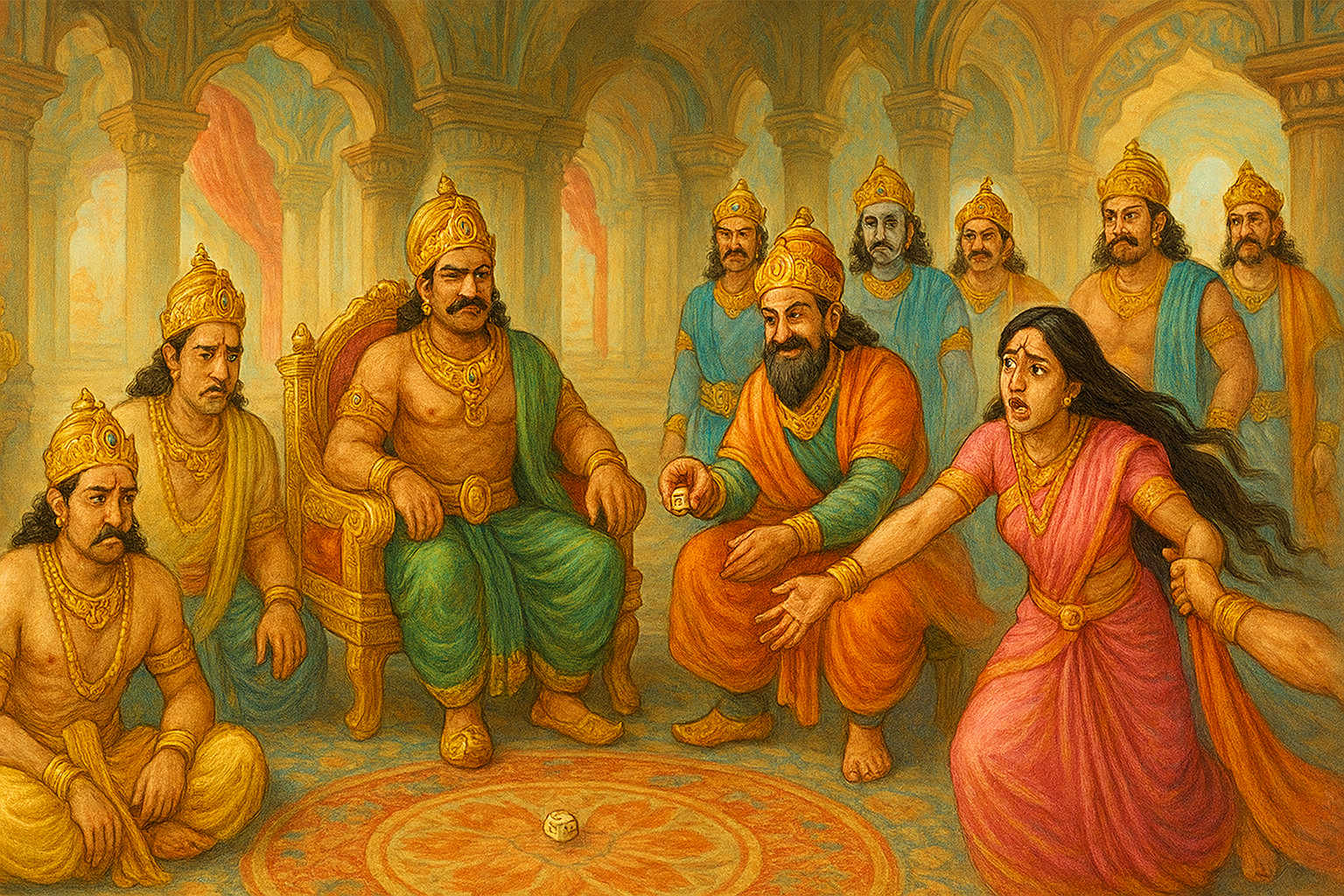
The seeds of this tragic incident were sown during the Game of Dice in the Sabha Parva of Mahabharata. Influenced by Shakuni’s cunning and driven by jealousy, Duryodhana invited Yudhishthira to a game of dice. Yudhishthira, bound by the kshatriya code of honor, accepted the challenge. The dice were loaded, and every throw brought defeat to Yudhishthira.
In a disastrous series of wagers, Yudhishthira lost his wealth, his kingdom, his brothers, himself, and finally, Draupadi. This set the stage for one of the darkest episodes in the epic.
Draupadi Is Summoned to the Court
When Dushasana was ordered to bring Draupadi to the royal court, she was in her private chambers. Shocked and humiliated, Draupadi questioned the legality of Yudhishthira’s act:
“Could a man who has lost himself still stake his wife?”
Her question shook the foundations of dharma, but no one gave her justice. The elders—Bhishma, Drona, Kripacharya—remained silent, bound by their loyalty to the throne.
Despite her protests, Dushasana dragged Draupadi by her hair into the court. The sight of the queen of Indraprastha being treated this way horrified many, but the Kauravas mocked her mercilessly.
The Humiliation in the Assembly
Duryodhana, consumed by arrogance, taunted Draupadi and invited her to sit on his lap. In a moment of extreme cruelty, he ordered Dushasana to disrobe Draupadi in front of the entire assembly. This was the ultimate insult—not just to Draupadi but to womanhood itself.
Draupadi’s Prayer and Krishna’s Grace
Helpless and alone, Draupadi tried to hold her saree with all her strength, pleading for justice. When no one came to her aid, she closed her eyes and raised her hands in surrender to Lord Krishna, praying with utmost devotion:
“O Govinda! O Madhusudana! O Protector of the helpless, save my honor!”
Her surrender was complete, and in that moment, the divine responded. As Dushasana began pulling her saree, Krishna made her cloth endless. The more he pulled, the more fabric appeared. Exhausted and humiliated, Dushasana collapsed, unable to strip Draupadi. The court was stunned—this was no ordinary miracle but a display of divine grace.
The Reactions in the Court
The miraculous event silenced the assembly. The elders realized the enormity of the Kauravas’ sin, yet none spoke against it. Draupadi, though saved by Krishna, vowed never to forgive the insult. Bhima swore to tear apart Dushasana’s chest and drink his blood, and to break Duryodhana’s thigh for his obscene gesture. These vows would later play out on the battlefield of Kurukshetra.
The Aftermath – Seeds of War
Dhritarashtra, fearing destruction, tried to pacify Draupadi by granting boons. She used them to free her husbands but refused any personal favors. Yet the damage was done—the honor of the Pandavas and Draupadi was trampled. The humiliation became one of the chief causes of the Mahabharata war.
Lessons from Draupadi’s Vastraharan
-
Faith in the Divine: Draupadi’s complete surrender to Krishna teaches the power of devotion and faith.
-
Failure of Dharma: The silence of the elders highlights that neutrality in the face of injustice is a sin.
-
Humiliation Leads to Conflict: The Kauravas’ arrogance and cruelty set the stage for their own destruction.
-
Women’s Honor Is Paramount: The incident emphasizes the sanctity of respect toward women in society.
The Spiritual Significance
The episode of Vastraharan is not just about humiliation and miracle—it symbolizes that when human effort fails, divine grace takes over. Draupadi’s salvation came not through her strength but through unconditional surrender to Krishna. This moment teaches the timeless truth: “Where there is dharma, there is Krishna, and where there is Krishna, there is victory.”
Conclusion
Draupadi’s Vastraharan remains one of the most emotional and significant episodes of the Mahabharata. It exposes the darkness of human greed but also shines as a beacon of divine protection. It reminds us that while adharma may triumph for a while, in the end, righteousness and faith always prevail.