Lord Rama’s Return – The Story Behind Diwali
Diwali, or Deepavali, is one of the most celebrated festivals in India, known for its vibrant lights, colorful decorations, and joyous celebrations. But beyond the grandeur lies an ancient story from the Ramayana—the return of Lord Rama to Ayodhya after 14 years of exile. This event is not only a tale of victory and reunion but also a profound reminder of the triumph of good over evil, light over darkness, and truth over falsehood.
The Background: Rama’s Exile and Ravana’s Defeat
The roots of Diwali trace back to the time when Lord Rama, the prince of Ayodhya and the seventh incarnation of Lord Vishnu, was sent into exile for 14 years due to a promise made by his father, King Dasharatha, to Queen Kaikeyi. Rama, accompanied by his devoted wife Sita and loyal brother Lakshmana, accepted the exile without hesitation, upholding dharma (righteousness) even in adversity.
During this period, the demon king Ravana of Lanka abducted Sita, leading to the great war between Rama and Ravana. With the help of Hanuman, Sugriva, and the Vanara Sena (monkey army), Rama waged a fierce battle, ultimately defeating Ravana and rescuing Sita. The victory of Rama over Ravana symbolizes the eternal truth that good always prevails over evil.
The Triumphant Return to Ayodhya
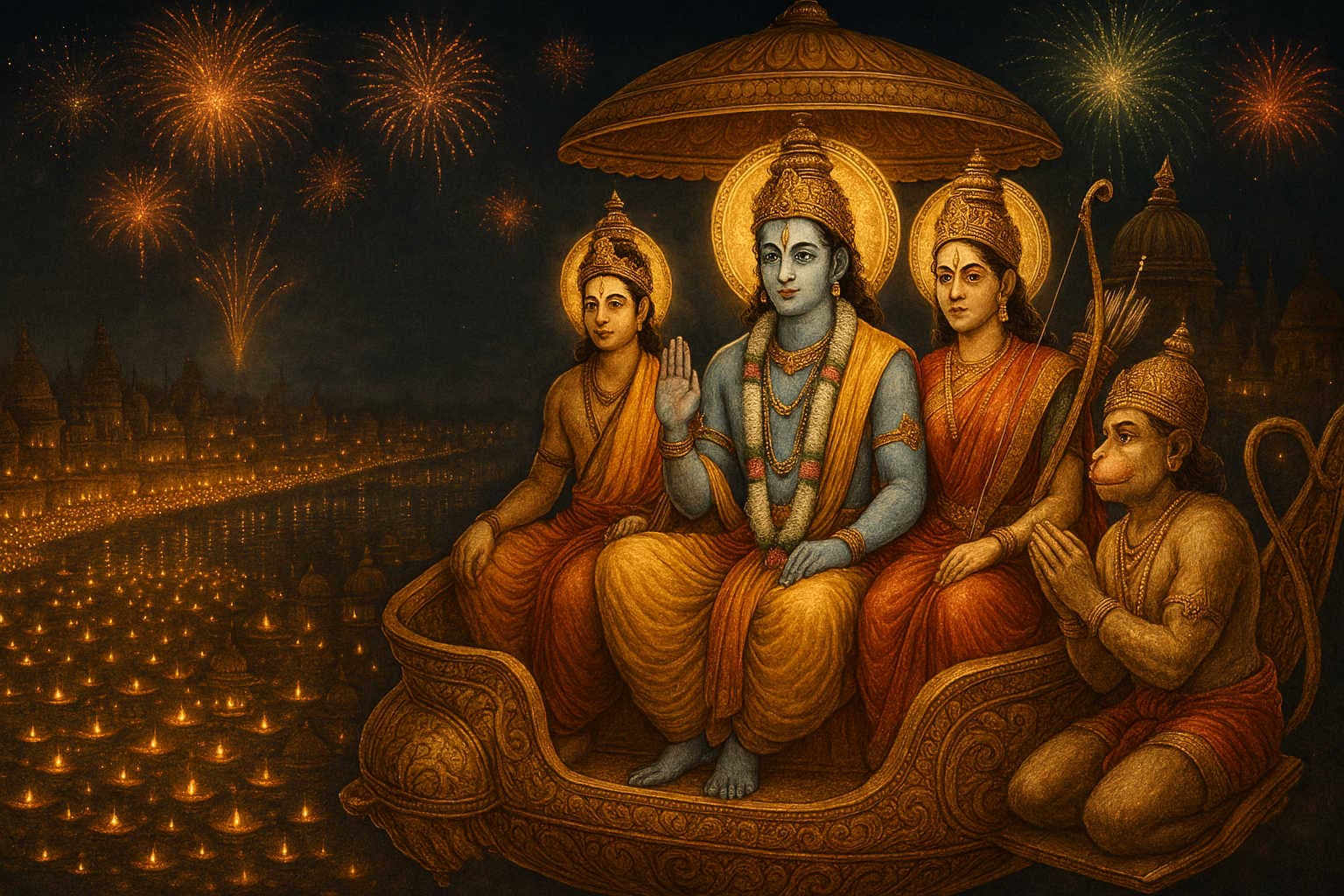
After the victory in Lanka, Rama, Sita, and Lakshmana prepared to return to Ayodhya. They traveled in the Pushpaka Vimana, a divine aerial chariot given by Kubera and used by Ravana. The entire kingdom of Ayodhya, which had been mourning Rama’s absence for 14 long years, burst into joy at the news of his return.
To welcome their beloved prince and future king, the people of Ayodhya cleaned their homes, decorated the streets, and lit rows of oil lamps—diyas—to illuminate the city and celebrate the end of darkness. These lamps became a symbol of hope, positivity, and victory. The night of Rama’s return, filled with glowing lights and heartfelt devotion, is celebrated as Diwali.
Why Do We Celebrate Diwali?
The lighting of lamps during Diwali is not just for decoration—it holds deep spiritual significance. It represents the removal of ignorance and darkness from our lives and the welcoming of knowledge, goodness, and divine blessings. Just as Rama returned to his rightful throne, Diwali reminds us to restore righteousness in our lives.
The festival also teaches us lessons in patience, loyalty, and truthfulness—values that Rama and Sita embodied throughout their journey. It is a time to cleanse our hearts, let go of negativity, and begin anew with positivity and light.
Traditions and Rituals Linked to Rama’s Return
-
Lighting of Diyas: Symbolizing the lamps lit in Ayodhya to welcome Rama, people light diyas in their homes and courtyards.
-
Lakshmi Puja: Goddess Lakshmi, the goddess of wealth and prosperity, is worshipped during Diwali to invite abundance and blessings.
-
Rangoli Decorations: Beautiful patterns adorn the entrance of homes to welcome good fortune.
-
Exchanging Gifts and Sweets: A gesture of love, unity, and happiness among family and friends.
-
Bursting Firecrackers: Signifying joy and the victory of light over darkness.
The Spiritual Essence of Rama’s Return
Diwali is more than a festival—it is a spiritual awakening. Lord Rama’s return marks the restoration of dharma and justice. It reminds us that after every dark phase, light will shine again, and after every hardship, there is hope.
This story also teaches that living a life of righteousness, compassion, and humility will always lead us back to our true home—peace and harmony within ourselves.
Modern Celebrations of an Ancient Tradition
While the essence of Diwali remains rooted in the Ramayana, the festival has evolved into a celebration of togetherness. Today, Diwali unites families, friends, and communities across the world. The lights of Diwali now brighten cities globally, but the message remains unchanged—victory of good over evil and light over darkness.
Conclusion
The return of Lord Rama to Ayodhya is more than a historical or mythological event—it is a living story that inspires millions. Diwali is not just about lighting lamps but about igniting the inner light of goodness, truth, and positivity. When we celebrate Diwali, we honor not just Rama’s victory but also the universal principle that righteousness will always prevail.
So this Diwali, as you light a diya, remember the story of Rama’s return and let its message illuminate your heart.