Agni Pariksha of Sita
The Ramayana, one of the most revered Hindu epics, is filled with profound lessons about duty, righteousness (dharma), and the complexities of human emotions. Among its many episodes, the Agni Pariksha of Sita remains one of the most debated and symbolic moments. This event, which occurs after Lord Rama defeats Ravana and rescues Sita, has been interpreted in multiple ways—through spiritual, cultural, and moral perspectives. But what exactly happened, and why is this story still discussed thousands of years later? Let’s dive deep into the meaning and relevance of Sita’s Agni Pariksha.
The Context: Return from Lanka
After the fierce battle in Lanka, Lord Rama triumphs over Ravana with the help of Hanuman, Lakshmana, and the Vanara Sena. The world rejoices, and the devas shower blessings from the heavens. However, amidst this celebration, Rama faces a challenge that tests his role as an ideal king and protector of dharma.
When Sita is brought before him, Rama’s heart is filled with love, yet he addresses her in a manner that shocks everyone present. He declares that though he defeated Ravana and fulfilled his duty as a husband, doubts about Sita’s purity linger because she lived in another man’s palace. As a king, Rama feels compelled to uphold societal expectations and maintain his people’s trust. This sets the stage for the Agni Pariksha.
The Fire Test – A Divine Ordeal
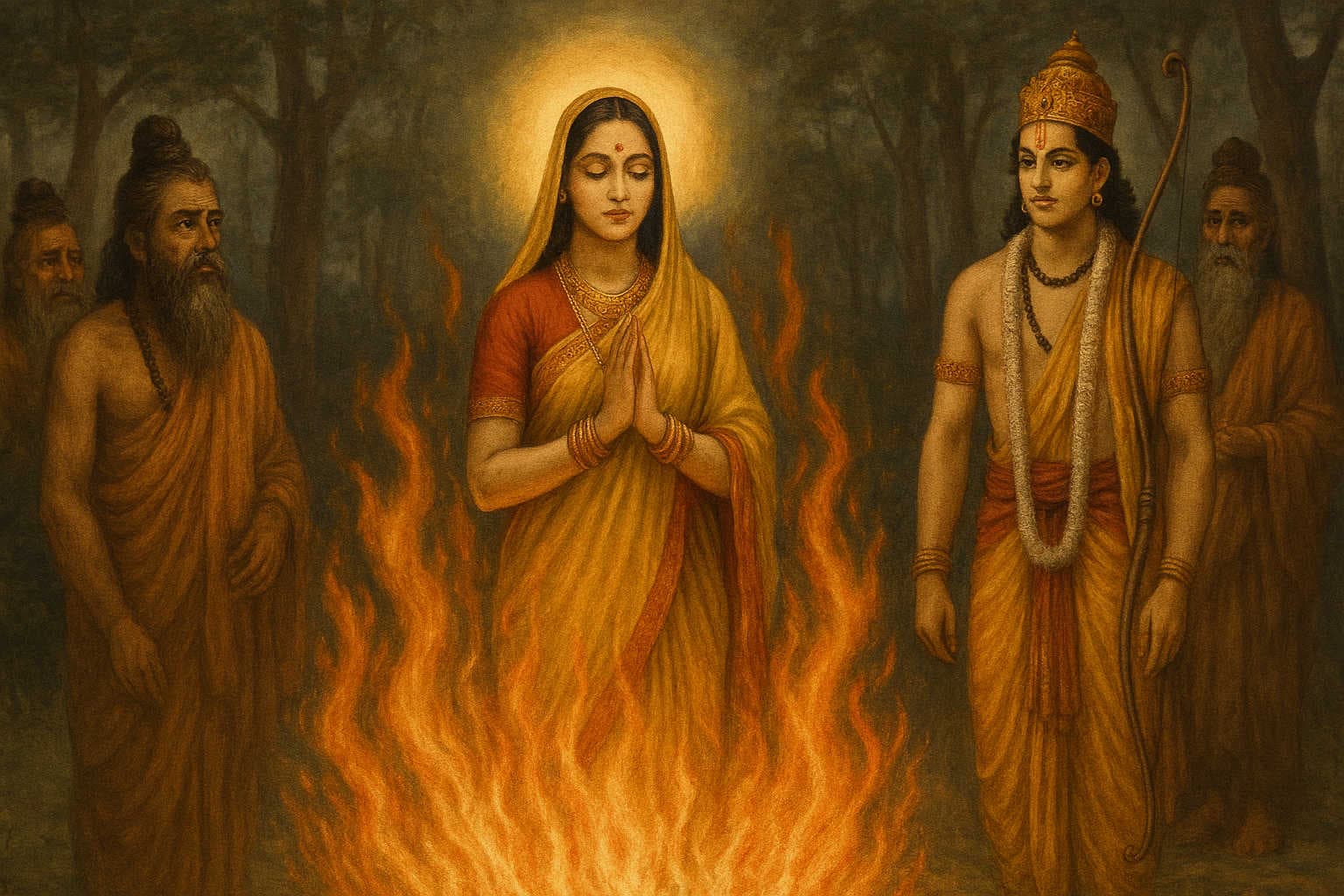
Sita, deeply hurt by Rama’s words, does not protest with anger but with dignity. She asserts that her heart has remained pure and her love unwavering. To silence every doubt, she chooses to undergo the ultimate test—walking through fire. With calm faith in her innocence and devotion to Rama, Sita prays to Agni, the fire god, to protect her if she is truly pure.
The pyre is lit, flames rise high, and Sita steps into the fire. To everyone’s astonishment, Agni himself appears, carrying Sita unharmed and radiant, declaring her purity beyond question. This miraculous event reaffirms her chastity, strength, and divine nature. Rama accepts her back with honor, and the world acknowledges Sita as an embodiment of virtue.
Symbolism of the Agni Pariksha
At first glance, the Agni Pariksha may seem like an unfair trial, questioning a woman’s dignity. However, in the spiritual context of the Ramayana, it symbolizes something deeper:
- Purity of Mind and Soul: Fire, in Vedic tradition, represents truth and purification. Sita’s trial by fire shows that true virtue cannot be tarnished by external circumstances.
- Faith and Courage: Sita’s willingness to undergo the ordeal demonstrates supreme faith in divine justice and courage to face adversity.
- Dharma vs. Personal Emotion: Rama’s decision highlights the conflict between personal love and public duty, a recurring theme in Hindu epics.
Cultural Interpretations and Debates
The Agni Pariksha has sparked debates for centuries. Many view it as a commentary on patriarchal norms that demanded women to prove their chastity, while others interpret it as a symbolic episode rather than a literal event. Some versions of the Ramayana, such as the Adbhuta Ramayana and regional retellings, offer alternative narratives where Rama does not doubt Sita or where divine intervention clarifies her purity without the fire test.
Modern Relevance
Why does this story still matter today? In an era where gender equality and women’s dignity are central conversations, the Agni Pariksha invites us to reflect on societal judgments and the value of inner strength. It challenges us to see beyond appearances and recognize integrity, faith, and resilience as true measures of character.
Spiritual Lessons from the Agni Pariksha
1. Inner Purity is Indestructible – External situations cannot taint the goodness of a pure heart.
2. Faith Triumphs Over Fear – Sita’s absolute surrender to truth gives her strength to endure the ordeal.
3. Balance of Dharma – The episode shows that leadership often demands difficult choices, even when personal emotions conflict with societal expectations.
Conclusion
The Agni Pariksha of Sita remains one of the most powerful episodes in Hindu mythology, layered with meaning and open to interpretation. Whether we see it as a historical event, a symbolic story, or a spiritual metaphor, its core message is timeless: purity, faith, and truth will always emerge victorious, even through the fiercest trials. Sita’s courage continues to inspire generations, reminding us that real strength lies in steadfastness and unwavering devotion to righteousness.