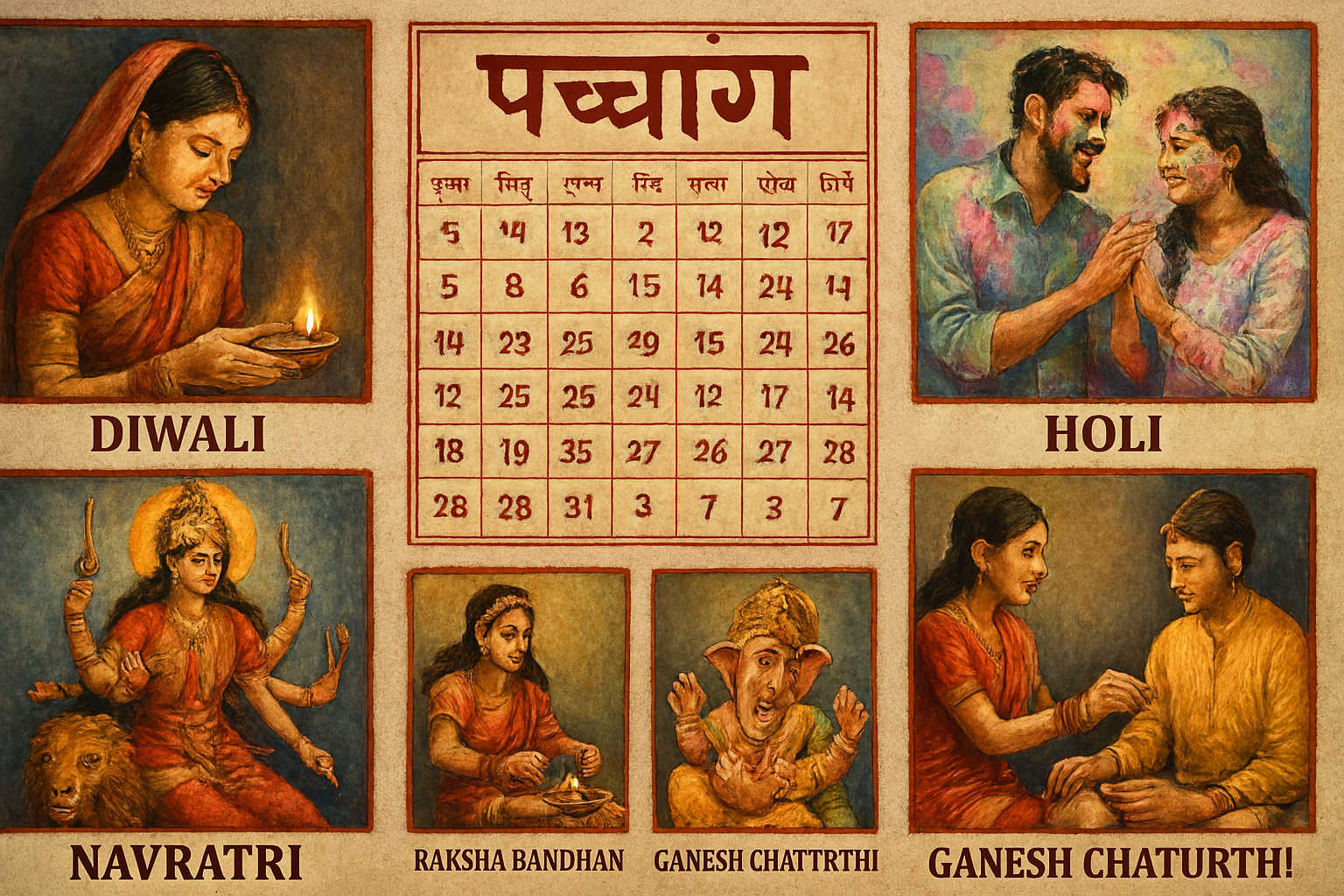
Festival Calendar for Hindu Year with Tithis
Hinduism is one of the world’s oldest spiritual traditions, and its festivals are deeply connected with cosmic cycles and natural rhythms. Unlike the Gregorian calendar, which is solar-based, the Hindu calendar (Panchang) is primarily lunar, with festivals and rituals determined by tithis—specific lunar days. Understanding these tithis not only helps devotees keep track of auspicious times but also reveals the deep connection between spirituality, astronomy, and culture.
1. What is a Tithi?
In Sanskrit, tithi refers to a lunar day. A lunar month has 30 tithis, divided between the waxing (Shukla Paksha) and waning (Krishna Paksha) phases of the moon. Each tithi carries unique significance and is associated with certain deities, rituals, and festivals.
2. Importance of Tithis in Hindu Festivals
Festivals are rarely tied to fixed Gregorian dates. Instead, they shift each year based on the lunar cycle. For example:
- Diwali falls on Amavasya (new moon) of the Kartik month.
- Holi is celebrated on Purnima (full moon) of the Phalgun month.
- Navratri begins on Pratipada (first day) of the bright fortnight in Chaitra and Ashwin months.
By observing tithis, devotees align their lives with cosmic energies, ensuring harmony with nature and divine forces.
3. Major Hindu Festivals and Their Tithis
Let us look at some of the most celebrated Hindu festivals and their associated lunar days:
- Makar Sankranti – Though primarily solar-based, it is aligned with the Sun’s movement into Capricorn (around January 14).
- Maha Shivaratri – Celebrated on the 14th night of the waning moon (Krishna Paksha Chaturdashi) in Phalguna.
- Holi – Falls on Phalgun Purnima, marking the victory of devotion and the arrival of spring.
- Rama Navami – Occurs on Chaitra Shukla Navami, the ninth day of the waxing moon in Chaitra month.
- Hanuman Jayanti – Observed on Chaitra Purnima.
- Akshaya Tritiya – On Vaishakha Shukla Tritiya, considered auspicious for wealth and prosperity.
- Guru Purnima – Celebrated on Ashadha Purnima, honoring teachers and gurus.
- Raksha Bandhan – Observed on Shravana Purnima.
- Krishna Janmashtami – On Ashtami (eighth day) of the Krishna Paksha in Bhadrapada.
- Ganesh Chaturthi – On Bhadrapada Shukla Chaturthi.
- Navratri – Starts on Ashwin Shukla Pratipada and continues for nine nights.
- Dussehra (Vijayadashami) – On Ashwin Shukla Dashami.
- Karva Chauth – On Kartika Krishna Chaturthi.
- Diwali – On Kartika Amavasya, followed by Govardhan Puja (Pratipada) and Bhai Dooj (Dwitiya).
- Makar Sankranti, Pongal, and Lohri – Though solar festivals, they are celebrated around mid-January.
4. Role of Panchang in Daily Life
The Panchang (Hindu almanac) guides people not only in festival dates but also in daily activities. It considers:
- Tithi (lunar day)
- Vara (weekday)
- Nakshatra (star constellation)
- Yoga (specific planetary alignment)
- Karana (half of a tithi)
By consulting these, priests determine the most auspicious time (muhurat) for weddings, pujas, and important undertakings.
5. Symbolic Connection of Festivals and Tithis
- The full moon (Purnima) symbolizes fullness, celebration, and devotion, which is why many joyous festivals fall on this day.
- The new moon (Amavasya) represents introspection and the victory of light over darkness, aligning with Diwali.
- The eighth day (Ashtami) is often associated with divine births, such as Krishna and Durga.
- The ninth day (Navami) reflects spiritual strength, hence Rama Navami and Maha Navami.
6. Regional Variations in Calendar and Tithis
India’s diversity leads to variations in how festivals are observed:
- In North India, the Vikram Samvat calendar is followed.
- In South India, the Shalivahana Shaka calendar is common.
- In Bengal and Assam, the Bengali and Assamese Panchang highlight Durga Puja and Bihu.
While the tithis remain central, the names of months and traditions vary.
7. Spiritual Significance of Following Tithis
Observing tithis helps devotees live in sync with cosmic energy. Instead of being mechanical dates, they invite reflection and awareness of time as divine rhythm. This rhythm of waxing and waning mirrors the cycles of life—growth, decline, and renewal.
Conclusion
The Hindu festival calendar, guided by tithis, is not just a schedule of celebrations but a spiritual map. It weaves astronomy, culture, and devotion into a tapestry of life’s rhythm. By following tithis, devotees align themselves with cosmic order, ensuring that every festival becomes a sacred opportunity for inner growth and divine connection.
As you glance at a Hindu calendar, remember—each festival’s tithi is not random but a chosen alignment of the moon, stars, and divine energies, guiding us on our spiritual journey.