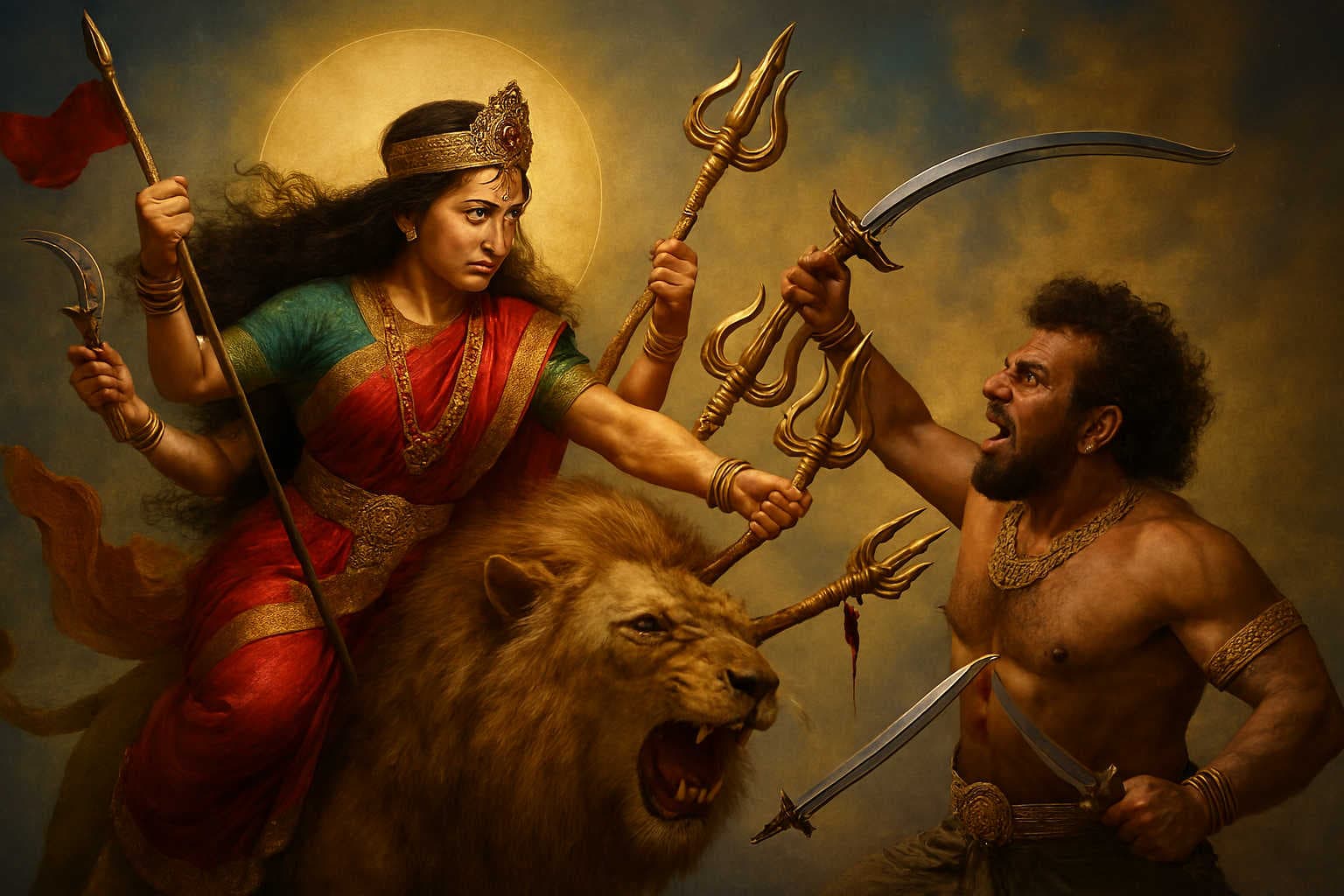
Story of Goddess Durga and Mahishasura
Hindu mythology is filled with stories that symbolize the eternal battle between good and evil, but few are as powerful and widely celebrated as the legend of Goddess Durga and Mahishasura. This story lies at the heart of Navratri and Durga Puja, festivals that celebrate the triumph of divine feminine energy over destructive forces.
1. Who Was Mahishasura?
Mahishasura was a powerful demon, born of a union between a demon father and a buffalo mother, which gave him the ability to transform between human and buffalo form. Through intense penance, he received a boon from Lord Brahma that no man or god could kill him. Empowered by this boon, Mahishasura became arrogant and began terrorizing heaven and earth, defeating the gods and claiming the throne of Indra, the king of the devas.
2. The Gods Seek Help
Unable to defeat Mahishasura, the gods sought a solution. Since Brahma’s boon stated that no man or god could kill the demon, the gods realized that only a divine feminine force could end his tyranny. In their desperation, the Trinity—Brahma, Vishnu, and Shiva—along with all other gods, combined their powers to create a supreme goddess filled with Shakti (divine energy).
3. Birth of Goddess Durga
From the radiance of the gods emerged Goddess Durga, a magnificent warrior goddess with ten arms, each carrying a weapon gifted by the gods: Vishnu’s discus, Shiva’s trident, Indra’s thunderbolt, and many others. Mounted on a ferocious lion, she embodied courage, wisdom, and unstoppable energy. She was hailed as Mahishasura Mardini, the destroyer of Mahishasura.
4. The Great Battle
The battle between Durga and Mahishasura raged for nine days and nights. Mahishasura, using his power of transformation, fought fiercely—shifting between his buffalo, lion, elephant, and human forms. But Goddess Durga, with her divine strength and calm determination, countered each attack with skill and grace. Her lion roared across the battlefield, while her weapons unleashed destruction upon the demon army.
5. The Defeat of Mahishasura
On the tenth day, Mahishasura returned to his buffalo form and charged at the goddess. With immense power, Durga pinned him down with her trident and struck the final blow, ending his reign of terror. This day became known as Vijayadashami (Dussehra), symbolizing the victory of righteousness over evil, light over darkness, and divine power over arrogance.
6. Symbolism of the Story
The tale of Durga and Mahishasura is not just mythology—it carries profound spiritual meaning:
- Durga as Shakti: She represents the unstoppable power of the feminine divine, reminding us that true strength lies in balance and righteousness.
- Mahishasura as Ego and Negativity: The demon symbolizes arrogance, ignorance, and destructive desires that must be conquered within us.
- Nine Nights of Battle: The nine days of Navratri represent stages of inner purification—destroying tamas (inertia), rajas (selfish activity), and awakening sattva (purity and wisdom).
7. Cultural Celebrations of the Story
- In West Bengal, Durga Puja is celebrated with grandeur, where idols of Durga slaying Mahishasura are worshipped before being immersed in rivers.
- In Gujarat and Maharashtra, the story is remembered through Navratri dances like Garba and Dandiya.
- In South India, families set up Bommai Golu (doll displays) depicting scenes from Durga’s victory.
- In North India, Ramlila and Dussehra celebrations also merge the theme of good triumphing over evil.
8. Lessons for Modern Times
The legend of Durga and Mahishasura continues to inspire people today. It teaches us that evil—whether in the form of injustice, ego, or negativity—can be overcome through courage, unity, and divine faith. It also highlights the importance of feminine energy, which is as vital as masculine power in maintaining cosmic balance.
Conclusion
The story of Goddess Durga and Mahishasura is more than a myth—it is a timeless reminder of the power of truth, courage, and divine grace. Each year, as devotees celebrate Navratri and Durga Puja, they relive this great battle, not only as an external festival but also as an inner journey of overcoming negativity and embracing the goddess within.
By remembering Durga’s victory, we honor the eternal truth that good will always prevail over evil, no matter how powerful the darkness seems.