Ram’s Departure to Vaikuntha
The Ramayana, one of the greatest epics of Hindu tradition, narrates the life and virtues of Lord Rama, the seventh avatar of Lord Vishnu. While the world knows the glory of his reign in Ayodhya, very few know about the final chapter of Rama’s earthly life—his departure to Vaikuntha, the supreme abode of Lord Vishnu. This story signifies the ultimate purpose of his avatar: to uphold dharma and then return to his eternal home.
The Reign of Rama – A Golden Era
After defeating Ravana and rescuing Sita, Lord Rama returned to Ayodhya and was crowned king. His reign, known as Rama Rajya, became the ideal of governance—just, prosperous, and filled with happiness. Every citizen lived in peace, and dharma was established firmly. However, even the divine incarnations have an appointed time on earth, and Rama’s departure was destined after fulfilling his mission.
The Seeds of Separation
After Sita’s departure to Mother Earth, Rama continued his duties as king but lived a life of detachment. His love for Sita was eternal, and her absence made his earthly existence feel incomplete. Still, Rama stayed to uphold dharma and ensure Ayodhya remained a land of righteousness.
As time passed, Lord Vishnu’s celestial message came: the purpose of Rama’s incarnation on earth was complete, and it was time to return to Vaikuntha.
The Messenger from Vaikuntha
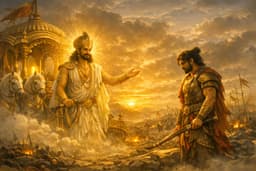
One day, the sage Kala (Time) arrived in Ayodhya as a messenger of the divine. Disguised as an ascetic, he met Lord Rama and delivered the message that Rama’s earthly time was over. He reminded Rama of his true identity as Vishnu and said:
"O Lord, the mission for which you descended upon earth has been fulfilled. The time has come for you to return to your eternal abode."
Rama, calm and serene, accepted this gracefully. However, he vowed to leave only after ensuring that his beloved subjects were cared for and that his departure would not disturb the harmony of Ayodhya.
Ram’s Final Arrangements
Before leaving, Rama appointed his brothers Bharata and Shatrughna to perform certain royal duties and make arrangements for the kingdom’s future. Lakshmana, his closest companion, was also destined to depart before Rama, as he was an incarnation of Sheshnag, who serves Vishnu eternally in Vaikuntha.
A twist of fate hastened Lakshmana’s departure. To protect a secret meeting between Rama and Kala, Lakshmana bore an unavoidable curse—leading him to leave the mortal world before Rama. Heartbroken but resolute, Rama accepted this as divine will.
The Great Departure
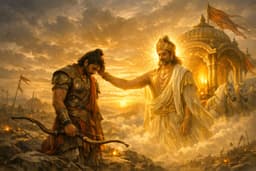
After Lakshmana’s departure, Rama summoned the citizens of Ayodhya and revealed his intention to leave the earthly realm. Shocked and grief-stricken, the people pleaded with him to stay, but Rama gently explained that every avatar must return to its divine source.
With deep reverence, Rama walked to the banks of the sacred river Sarayu. His brothers, ministers, sages, and citizens followed him, unable to let go of their beloved king. Hanuman, his most devoted servant, was overcome with grief and begged to accompany him, but Rama instructed Hanuman to stay on earth to protect devotees and spread dharma.
Return to the Eternal Abode
As Rama entered the waters of the Sarayu, he assumed his divine form—Lord Vishnu, adorned with the Shankha (conch), Chakra (discus), Gada (mace), and Padma (lotus). A brilliant light filled the sky, and celestial beings descended to welcome him. Accompanied by chants of Vedic hymns, Rama rose from the earthly realm and returned to Vaikuntha, his eternal abode.
The people of Ayodhya who loved Rama dearly also followed him into the river, attaining liberation by merging with the divine.
Symbolism of Rama’s Departure
The story of Rama’s departure is not just about the end of an avatar’s earthly life—it carries deep spiritual meaning:
-
Detachment and Duty: Even as an incarnation of God, Rama fulfilled his duties until the very end, teaching that responsibility comes before personal desire.
-
Impermanence of Life: Everything in the material world is temporary—even the divine takes form and leaves after completing its mission.
-
Ultimate Liberation: The goal of life is to return to the eternal abode by living a life of righteousness and devotion.
Legacy of Rama
Though Rama departed to Vaikuntha, his ideals remain immortal. His life and departure remind devotees of the importance of dharma, humility, and truth. Temples across India celebrate Rama Navami (his birth) and also revere his final journey, emphasizing that devotion to Rama leads one to ultimate liberation.
Conclusion
Lord Rama’s departure to Vaikuntha is one of the most divine moments in the Ramayana’s concluding chapters. It shows that the avatar comes for a purpose, fulfills it, and then returns to the eternal source. For devotees, it is a reminder that the Lord is always with them—beyond time, beyond death, in the infinite Vaikuntha.